
Thursday, April 2, 2026
Over 7,500 Small Businesses Served (and Counting)
An interim report on the Small Business Support Hubs program found over 7,500 established businesses had been served as of June 2025 by Michigan’s 27 hubs, in every county of the state
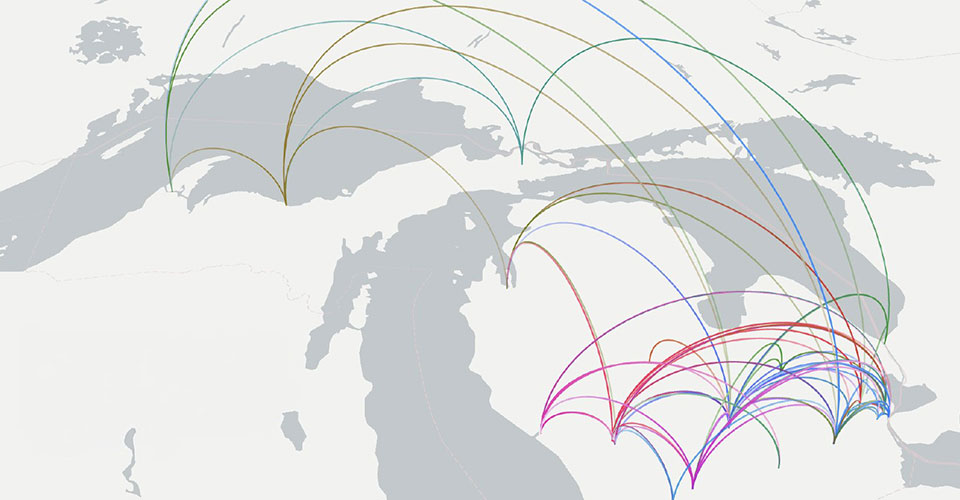
Since its start in December 2023, the Small Business Support Hubs (SBSH) program from the Michigan Economic Development Corporation (MEDC) has provided a statewide network of 27 Support Hubs equipped to serve the needs of small businesses.
While each is slightly different in its service area and emphasis, all the hubs help entrepreneurs and business owners to navigate the sometimes-confusing world of resources and requirements as they develop, establish and grow their business. This might include helping develop a business plan to secure funding, growing a customer base and industry connections or hiring and managing employees.
Through the program, the MEDC has also raised the capability of each of these 27 organizations to manage Federal funding, positioning organizations in all ten prosperity regions for future local and regional community and economic development funding opportunities.
In October 2024, MEDC contracted Public Policy Associates (PPA) to evaluate the SBSH program. Based on outcomes reported by the hubs between December 2023 and June 2025, PPA shared some of the initial findings of its evaluation in an interim report, intended to offer an early glimpse into the program’s progress and lessons learned that will inform its future evolution.
The success of small businesses requires a combination of entrepreneurial determination, passion, adaptability and strategic awareness. However, without the support of a robust entrepreneurial ecosystem, even the strongest small businesses may struggle. Through the Small Business Support Hubs program, the Michigan Economic Development Corporation has invested in this ecosystem, bringing new and scaled resources to Michigan businesses through a strong and effective partner network.
The Small Businesses Receiving Service
As of June 2025, Michigan’s network of hubs had served more than 7,500 established businesses (and over 8,800 as of Feb. 2026.) Most of these were severely constrained in staff capacity and experience; 90% were considered microbusinesses, with fewer than 10 employees, and 67% were new or early-stage businesses that had been in existence for three years or less. Only 5% were considered second-stage businesses, with 10 or more full-time employees and more than $1 million in revenue. Over 5,000 jobs were created through these efforts, and another 28,000 existing jobs were supported.
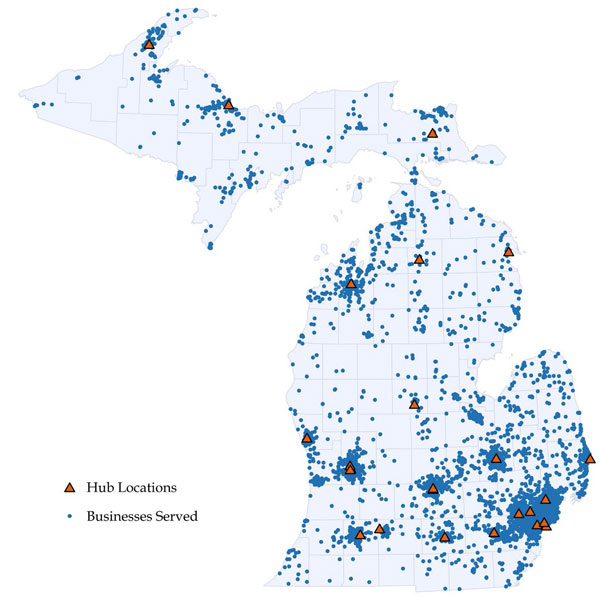
The range of approaches practiced by the 27 hubs provided important data; as PPA notes, “some hubs focus on relatively brief ‘light touch’ education and outreach and seek to increase the volume of businesses served, [while] others focus on providing more intensive services delivered to a smaller number of businesses.”
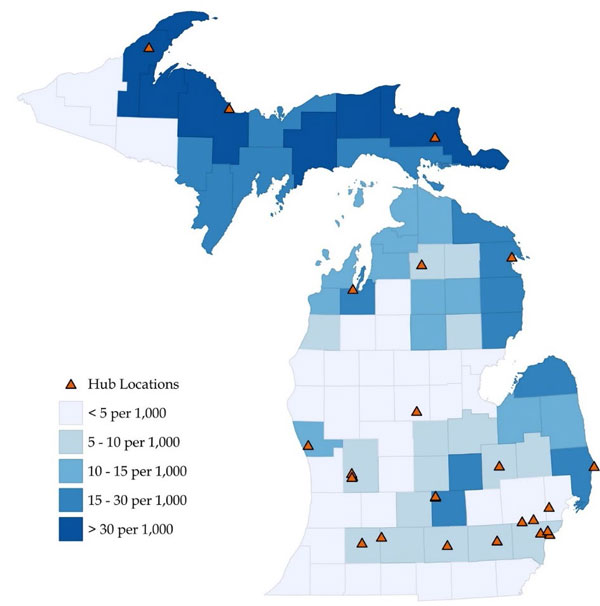
Businesses served by the SBSH program were found in every county of the state. While they were concentrated in the state’s more densely populated counties, a significant proportion of the small businesses in northern Michigan received service, indicating that these hubs were able to effectively reach many of the businesses that could benefit from services in their communities.
The Network of Expertise
Many small businesses accessed services from more than one hub, suggesting a forming ecosystem. Of the 7,910 clients served by the hubs, 346 were served by two or more hubs, often following common lines of connection and referral representing peer-to-peer relationships between hubs.
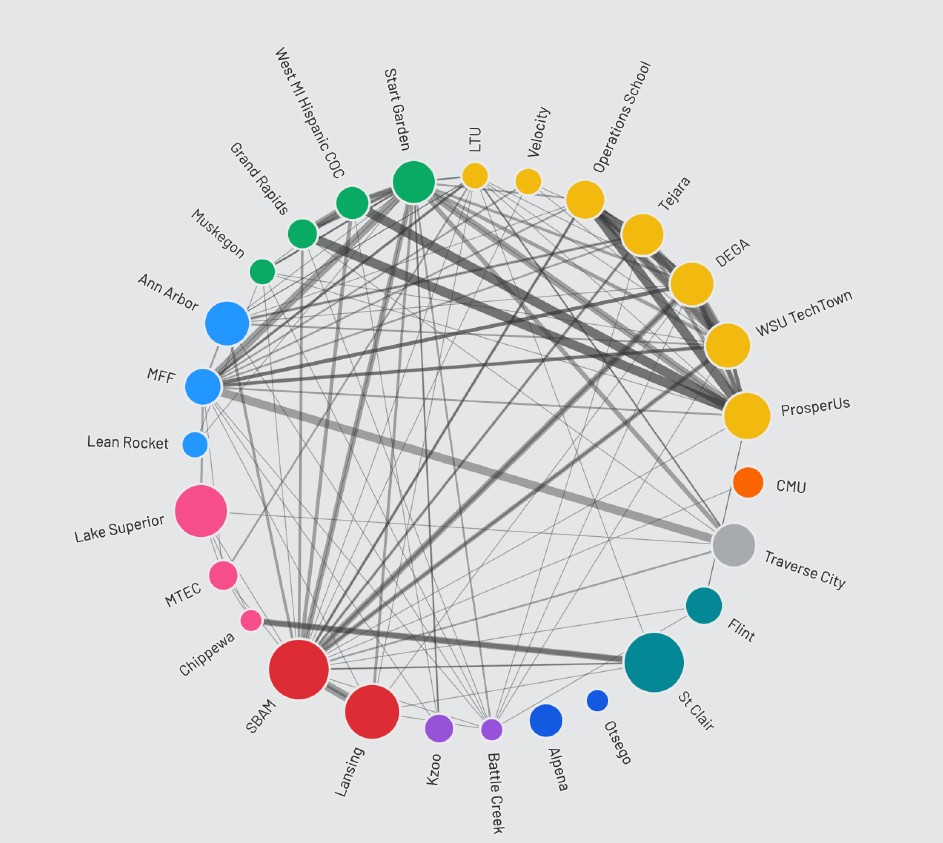
As part of the report’s recommendations, PPA suggested continuing to strengthen these connections: “From the start of the program’s implementation, MEDC has attempted to provide regular opportunities for representatives from the hubs to meet as a group... Feedback from the hubs suggests that [these] are very helpful, especially when they can use that time to learn from one another. Providing added support and structure for hub-to-hub interactions through a community of practice model could be an effective way to promote peer learning and group problem solving among the hubs.”
MEDC has laid the foundation for additional hub-to-hub interaction through monthly open office hours and quarterly meetings with SmartZone network partners and plans to extend further avenues for coordination as the program evolves.
What’s Next for the Support Hubs
To date, the SBSH program has been funded by a one-time appropriation using American Rescue Plan Act (ARPA) dollars to support small businesses impacted by COVID-19. In February 2026, the Michigan Strategic Fund board approved nearly $11.3 million in legislatively appropriated state funding for the next phase of the SBSH program.
Our Small Business Support Hubs have been a significant catalyst for increasing local, community-driven economic development and regional coordination for Michigan’s small businesses and entrepreneurs.
An estimated $8 million will be used for hub operations, programming and services, and regional ecosystem coordination, to be awarded through a competitive application process, while the other $3.3 million will be used for limited direct business assistance awards to eligible small businesses.
Awards to the selected hubs will be issued for an initial one-year term, with the option to extend yearly, for up to an additional two years subject to performance, available funds and approval by the MSF.
Learn more about the Small Business Support Hubs program and find a hub near you.