Monday, October 27, 2025
At the Battery Show, Michigan Charges Ahead
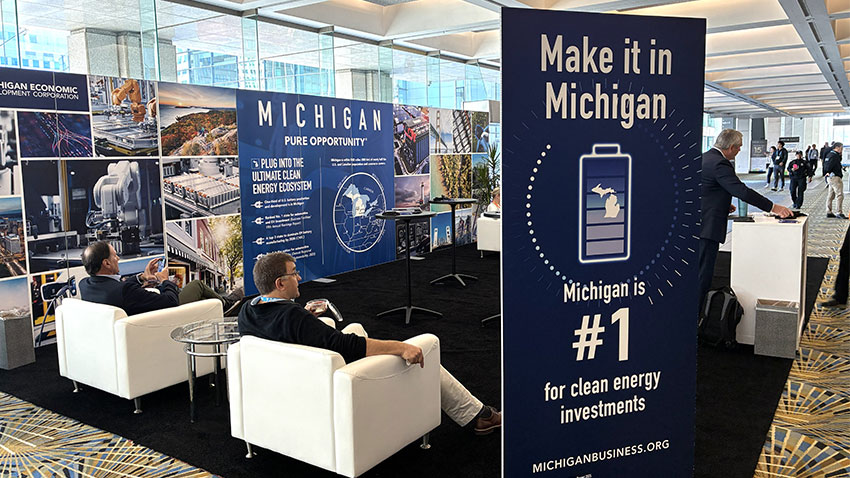
When the Battery Show and Electric Vehicle Tech Expo came to Detroit Oct. 6-9, 2025, more than 21,000 industry professionals gathered for four days of conference sessions, networking and displays from more than 1,300 global exhibitors at one of the world's largest battery technology trade shows, celebrating 15 years this fall.
Innovations in every niche and aspect of the battery industry were on full display, with process automation, chemistry refinements and a strong international presence from companies across Europe and Asia as emerging themes. State leaders including Governor Gretchen Whitmer, Lieutenant Governor Garlin Gilchrist II and Michigan Economic Development Corporation (MEDC) CEO Quentin L. Messer, Jr. toured the expo floor and met with company staff to learn about the latest advances.
Michigan companies from A to Z were well-represented, including several that have received past support from the MEDC. Their plans and passion illustrated the industry’s “full speed ahead” attitude, knowing that global competitiveness tomorrow depends on local innovation today.
American Battery Solutions (ABS)
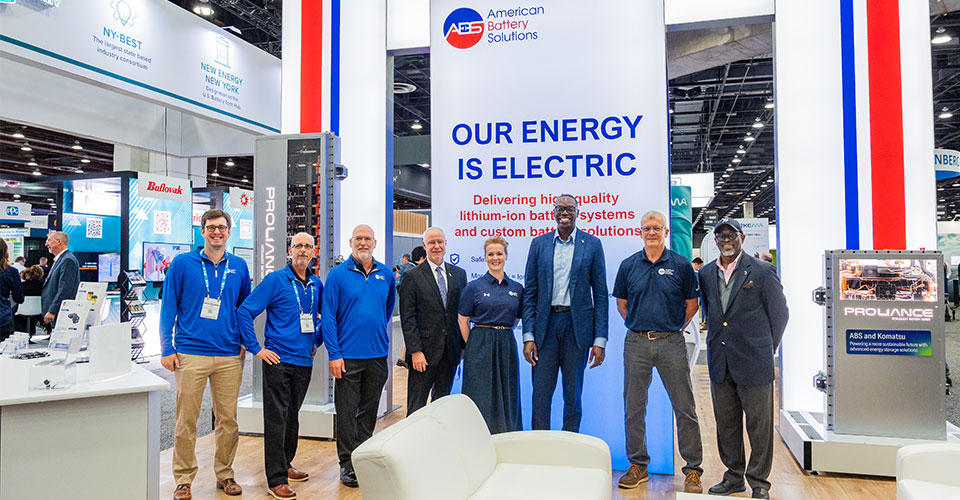
ABS, headquartered in Lake Orion and with 200 employees based in Michigan, focuses on battery packs rather than cells, targeting non-automotive markets like transit buses, fleet delivery vehicles, and industrial equipment. ABS opened its lithium-ion battery manufacturing facility in Lake Orion in 2019. In February 2024, the U.S. Department of Energy announced a conditional commitment for a $165 million loan for ABS to expand an assembly facility to supply next-generation battery packs, but ABS did not ultimately complete the loan.
Today, ABS has produced over 4,000 batteries for customers like New Flyer to use in the transit bus industry. “We’re seeing a lot of continued adoption [from New Flyer]. We’re delivering batteries in New York, Miami, the Washington metro area – all of the major cities are converting, and right now many are delivering with ABS batteries,” said Dr. John Warner, chief customer officer for ABS.
Looking ahead, ABS is expanding into last-mile delivery vehicles, producing about 2,000 batteries for an undisclosed customer in 2025 and ramping up to nearly 20,000 batteries a year at full volume. ABS was acquired by Komatsu in 2023, in support of Komatsu’s 2050 carbon neutrality goal.
Ann Arbor SPARK
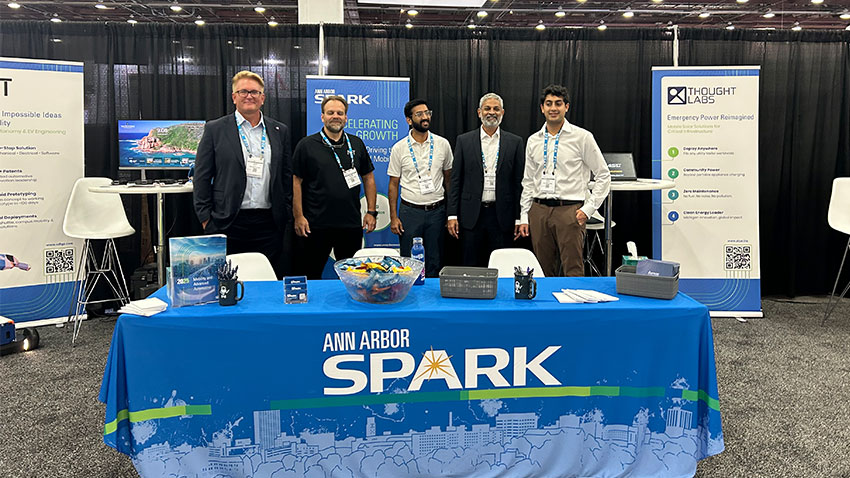
For more than 20 years, Ann Arbor SPARK has served the greater Ann Arbor region as a catalyst for economic development. SPARK’s presence at the Battery Show was partly to promote themselves as a great place to launch, expand, or relocate a business, and partly to feature several of their startups, one of which closed a pilot project as a result of their attendance at the Battery Show in 2024. Janis Seabolt, the director of mobility programs, works with entrepreneurs who are scaling up mobility technology of some kind. “The world is electrifying, and there are a lot of technologies that are enabled by the battery industry,” said Seabolt. “I think at the beginning of the year, everybody was white-knuckling a little bit around electrification. But I think in the end, the automotive industry cannot afford to lose market share globally. They’ve got to figure out how to work in this system. It’s going to happen.”
Startup technologies featured at the Ann Arbor SPARK booth included APT Solar Solutions’ vertical solar lighting system, Nift’s EV platform, Thought Labs’ emergency solar power solutions, and Satori XR’s AI-powered 3D visualizer.
Dow
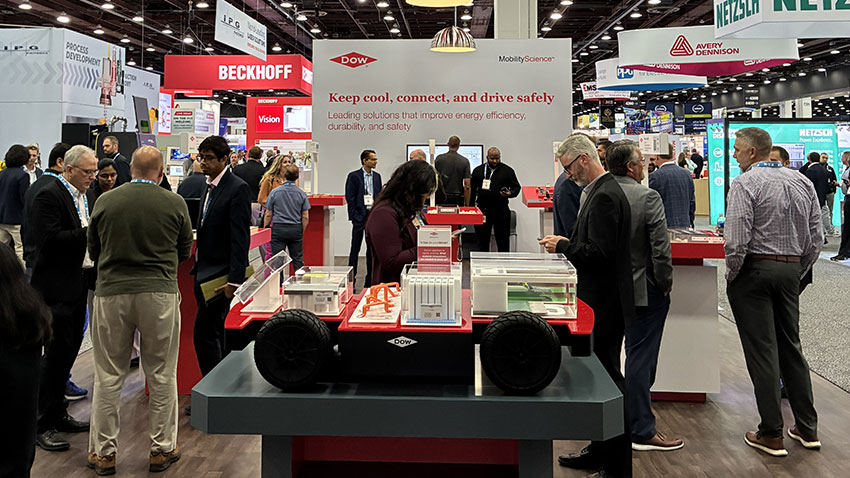
Dow is one of the world's leading materials science companies, founded in Midland, Michigan in 1897 and now operating manufacturing sites in 30 countries that employ approximately 36,000 people, for sales of approximately $43 billion in 2024. In July 2024, the Michigan Strategic Fund board approved support for Dow to modernize its Michigan Operations Industrial Park in Midland and the Auburn Operations facilities in Williams Charter Township, seeking to improve and expand manufacturing such as for silicone foams, gels, coatings, encapsulants and other materials for use in electric vehicle batteries and other technologies. Today, Dow is pressing forward with material innovation for the battery industry.
“At Dow, we have myriad solutions across the battery, both inside the cell and – especially – in assembly,” said Ryan Smith, global marketing director for Dow MobilityScience. “Dow manufactures across four different primary chemistry sets: silicones, polyurethane, polyethylene and then different acrylics, solvents and other miscellaneous chemistries, and each of those have a role to play inside and around the battery. What you see here at the booth is battery protection and thermal management.”
Dow's offerings include gap fillers and thermally conductive adhesives to protect battery cells, prevent thermal runaway and ensure long-term performance. “We have all the tools that customers need in our toolbox,” said Smith.
Reflecting on the state of the Battery Show, Smith said, “The industry is still growing. We continue to emphasize that there absolutely have been changes, but all they did is lower the growth rate. It’s still growing, on average, between 10 to 15% a year. It’s fun walking around the show. You see hundreds of entrepreneurs coming with fun ideas. It’s ambitious. It’s exciting. It’s a good energy to be around.”
UL Solutions
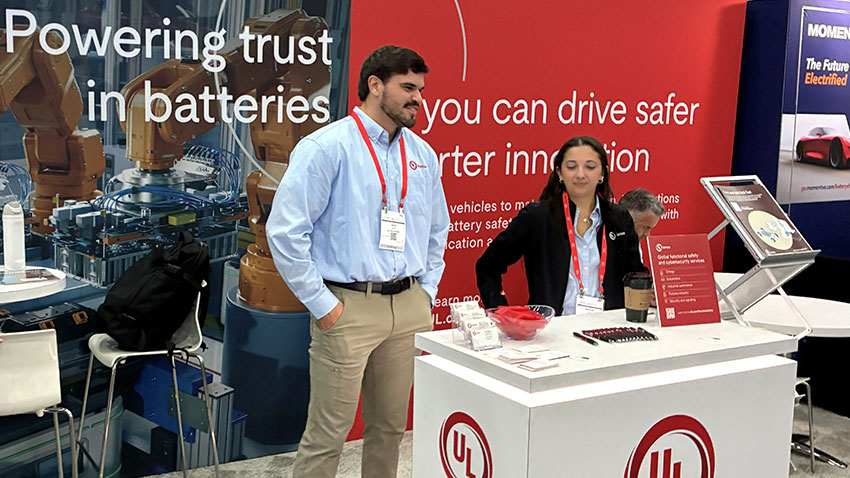
On August 7, 2024, UL Solutions, a global leader in safety science, opened its state-of-the-art Battery Lab in Auburn Hills. This $104 million investment, the largest in UL’s history, taps into Michigan’s position as a global hub for cutting-edge automotive and energy storage testing. Supported by a $1.5 million Michigan Strategic Fund grant, the lab serves as a testing facility to support battery manufacturers.
UL’s automotive team in Michigan focuses on testing, inspection and certification of automotive components, including environmental and mechanical testing, design and production validation. They differentiate by providing direct access to engineers for technical questions and navigating changing regulations.
UL also has an energy and industrial automation group that works with stationary battery applications. “At the Auburn Hills lab, we can do abuse testing, vibration testing, all the capabilities that go into getting a battery tested and certified. We’ve had a lot of in-person tours this week for customers who haven’t seen it yet,” said Maggie Ziem, a sales executive for UL. “We work with a lot of the companies here [at the Battery Show] already, so being face to face is always nice.”
ZF Test Systems
ZF is a global, Tier 1 automotive supplier focusing on various automotive, commercial vehicle and mobility-related technologies and test systems. With some 161,600 employees worldwide, ZF reported sales of €41.4 billion in fiscal 2024. The company operates 161 production locations in 30 countries.
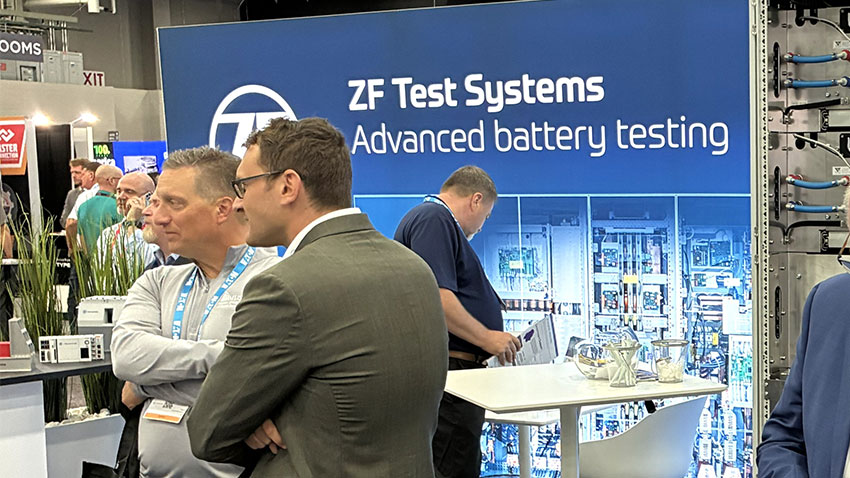
ZF Test Systems specializes in standardized test systems tailored to customer needs, including battery testing at the cell, module, and pack levels. According to Drew Steele, head of test systems for North America at ZF, testing is crucial to prove performance.
“Performance requirements are pretty steep. The performance of the battery is going to affect the salability of the car, and range is performance,” said Steele. “Automotive OEMs want to have control of the battery as part of their brand and their identity, almost like yeast in beer. If they control the chemistry, then they control performance.”
Steele felt positive about the connections ZF Test Systems made at the Battery Show. “This has been a spectacular show for us. I think the quality of people who are attending has been very good.” He also had confidence in the industry’s direction. “With electrification, there’s maybe a little bit of a speed bump, but it’s just a matter of time before it comes back around. You’ll see a distribution of powertrains, be it battery, gas, or diesel. But the electrification side will continue to grow, and southeast Michigan will continue to be a hub.”
Learn more about Michigan innovations in the energy industry.