Sweet and Sour
Phil and Sarah Hallstedt of Red Truck Orchards
With support from 20Fathoms, part of the MEDC-supported network of Small Business Support Hubs, the Hallstedts scaled up production of their delicious artisan cherry vinegar
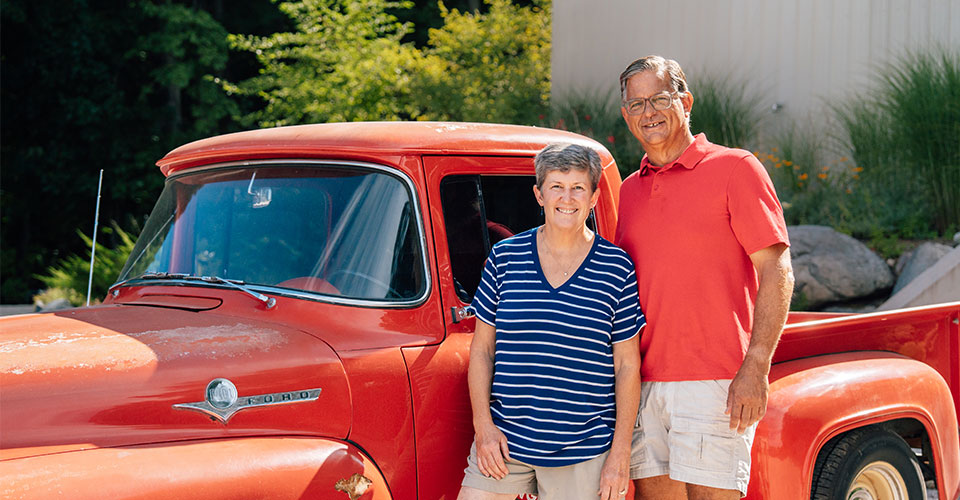
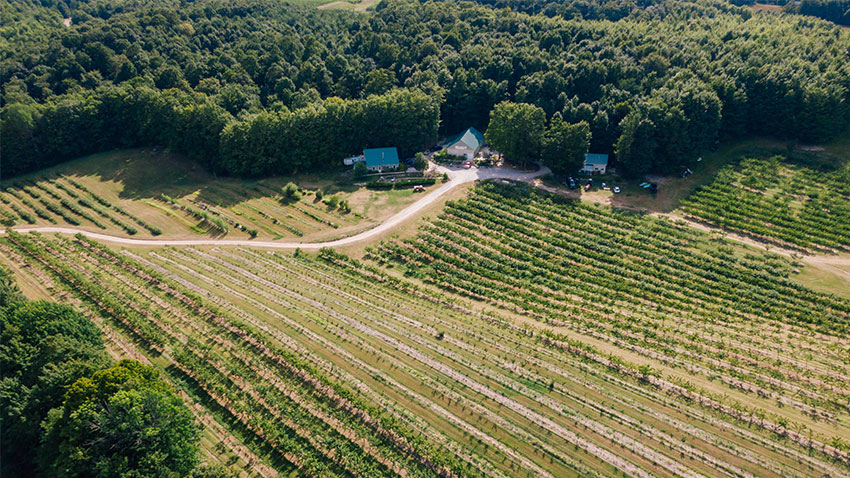
Phil and Sarah Hallstedt didn’t expect to become farmers. They met at the University of Michigan and raised a family in Indianapolis for 23 years, working in pharmaceuticals and accounting, before deciding to return to Michigan. Phil’s family roots date back to 1900 in the Leelanau Peninsula northwest of Traverse City, and the Hallstedts purchased 53 acres of farmland in the area in 2006. As their kids approached graduation, they planned for an “active retirement” with help from MSU Extension services.
The land was conducive to fruit production, and the Hallstedts joined a group of growers producing fresh sweet cherries for wholesale. They had a strong business case validated by MSU, cherry experts, local growers and a distributor, began planting in 2010 and moved up to the property in 2016. Unfortunately, the business case did not pan out in real time. When the COVID-19 pandemic hit in 2020, they pivoted to a U-pick model, which proved popular but not necessarily profitable.
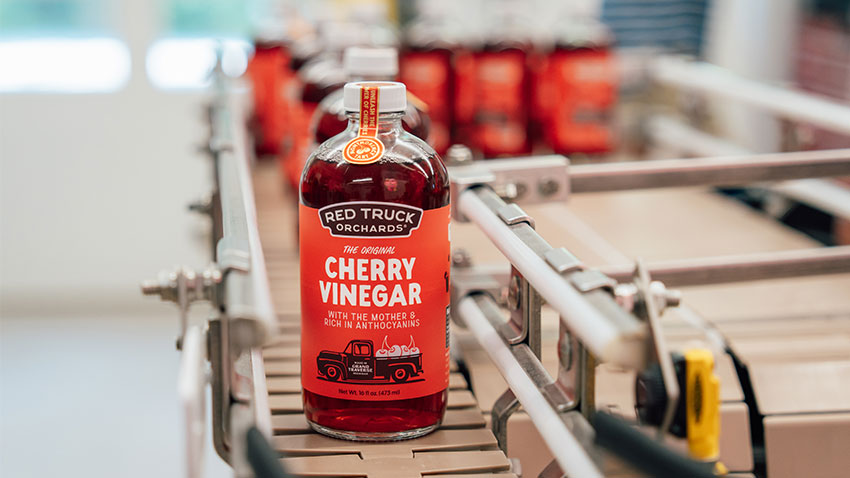
Today, the Hallstedts have found a new route to a thriving business: Red Truck Orchards cherry vinegar, fermented in their facility with a carefully cultivated “mother” of acid-producing bacteria. With help from 20Fathoms in Traverse City, part of the Small Business Support Hubs network supported by the Michigan Economic Development Corporation, they have successfully scaled up production from pints to tanks, earned distribution to grocery stores and delighted diners at their Cherry-Palooza, a chef-led luncheon incorporating the cherry vinegar into every course.
And yes: it tastes amazing.
Origin of the Species
Phil Hallstedt: My wife Sarah is the farmer and loves having her hands in the dirt. I’m the tinkerer and the mechanic, for the most part. New product development has always been my passion, and she’s allowed me to have a bunch of failures over time.
The idea for cherry vinegar came when we tried shrubs, which are a kind of vinegar‑based drink, in December 2022. Our kids brought them home for the holidays, and the apple cider vinegar taste was so strong. Sarah really did not like it. I was intrigued, so I started tinkering with my homemade cherry wine to convert it to vinegar. I could make a pint, but I couldn’t make a gallon.
We hired a local kombucha founder, Courtney Lorenz of Cultured Kombucha, who helped us develop a stable “mother” and a repeatable process for initial market testing. She describes being in her office when this farmer walks in and says, “Hey, I need some help. Can you help me?” I’m glad she said yes!
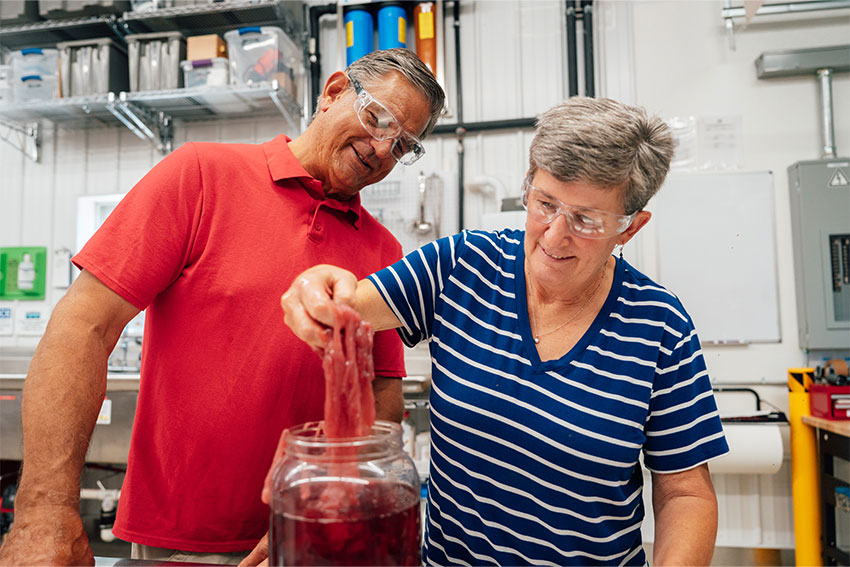
After about a year of making those test batches, we heard, “Wow, this is something really cool. You should pursue it.” That pushed us to hire an employee. Sam Reese brought a wealth of production experience from beer making at Bell’s plus a long passion in fermenting vinegars. He refined the initial recipe, mapped out critical process steps in the double fermentation process and evolved the acetobacteria “mother” to balance flavor and production.
One of our first milestones was creating a label, putting it on a bottle and hosting a luncheon for 80 people called Cherry-Palooza. Chef Jimmy Schmidt literally went from top to bottom, from hors d’oeuvres and drinks, mocktails, through the main course. Potato salad, coleslaw, pickled vegetables. Everything had the vinegar in it. The caramel gastrique and the Moomers vanilla ice cream… that was to die for. Some of it is subtle, but it was a great way to showcase how versatile the cherry vinegar is.
At that point we said, “Okay, now we are ready to scale.” We took a barn that was just steel and concrete and created a heated, 365‑day facility. It took close to a year not only to build it, but also to generate enough biomass so we could start looking at distribution.
We had to perfect the process. Courtney got us from pints to gallons. Sam got us from gallons to five gallons. Then he got us from five gallons to 375‑gallon containers.
Scaling is hard. The chemistry changes, the process changes. The vinegar is better now, more productive, faster. But we had to develop a whole new process as we scaled, because the initial process was not commercializable.
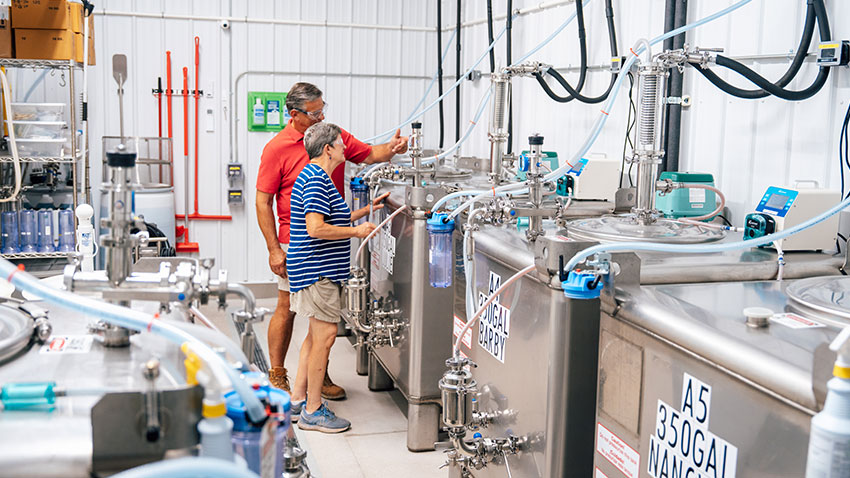
Sarah Hallstedt: As we were trying to grow the mother and everything else we needed, we were building out the barn, taking it from a pole‑barn shell and turning it into a state‑of‑the‑art manufacturing facility, bringing in custom steel tanks.
Phil jokes that we often get asked, “Are you ever going to have animals on the farm?” And he says, “No, I never wanted animals on the farm. They get sick and wander off.” But now he’s got billions of them.
Phil: They’re bacteria. They have a persona; each tank takes on a personality of its own. Each tank has to be watched closely. Sometimes those little critters go off on a tangent. We did a lot of generational development to create the culture as it evolved and select the proper one — the taste, the productivity, everything we needed.
We hired a professor from Purdue when we ran into roadblocks scaling up. He said, “To make wine is easy. To make good wine is hard. To make vinegar at the level you’re trying to do is downright difficult.” We didn’t know what we were getting into, but as we got more acquainted, we realized how special it was, and we poured more effort into it.
Falling Farther From the Tree
Phil: The path forward for a small startup is very difficult for getting on shelves. And the path we followed was to get into 30 to 50 outlets initially… the local grocers up here like Tom’s, Oryana, Oleson’s, but also little farm stands and wine shops. They were instrumental in getting us started and starting the interaction.
We’re in Meijer. We just got into Fresh Thyme. We just brought in our first distributor, Carmela. We’re growing. At the same time, we wanted a strong online presence. We’re now consistently shipping a thousand bottles per month, with customers in all 50 states.
We’re in restaurants that have used us as a branded item, like Black Star Farms. At Jacob’s Farm here in Traverse City, the bartender created a non‑alcoholic shrub with our vinegar, and she can add alcohol to it if people want. They want us to get more involved this fall, which is their busiest time.
All that really helps. We’ve just dipped our toe into the export market. This is early, but cherries are beloved in Asia, specifically China, Japan and Korea. The Korean market is really interested in bringing this over. You see the potential of it. We’re still small, so we’re taking little steps, very carefully, as we move forward.
Slushy Funds
Phil: 20Fathoms, as well as MSU Extension, have been at the heart of helping us identify people and resources. On Thursdays 20Fathoms has a breakfast lab and a speaker, and I come down to attend. 20Fathoms has people who are in business, but they also have support services — a network of accountants and people who are familiar with CPG goods, distribution, etc. We got involved maybe 18 months ago, started attending events and received a couple small grants early on, including one for a slushy machine.
We had some vinegar that second year, but we didn’t have our production facility up and running. So how do you build awareness when you have no product?
We stretched it and made it fun! We made a raspberry cherry‑vinegar slushy and a lemonade cherry‑vinegar slushy. At farmers markets, one bottle can stretch to 20 or 30 servings. We started collecting data sets, contacting people and telling them about the vinegar. That was our first summer in 2025.
Sarah: Even when we’re standing at a farmers market, we have to go out of our way to get people interested, because they see “cherry vinegar” and say, “Oh, that’s interesting,” and keep walking.
But if we give samples and say, “Hey, do you want to try something different? We’ve got this raspberry slushy, it has some of our cherry vinegar in it.” People either say, “No way, it’s too early in the morning,” or they assume it’ll be very vinegary. It’s not. It’s just enough to pull the flavor forward, elevate it. Once you give them a sample, their eyes light up and they say, “Wow, this is really good.” Especially on a hot day, it’s a win.
The slushy machine cost a little over $4,000, and that generated awareness our first year. We didn’t have much inventory to sell in terms of vinegar, so it was hugely helpful. 20Fathoms also gave us a grant with MEDC support that helped us research and really understand our market. Who was the customer? What was their intent to purchase, why would they be interested?
Phil: As we move forward, they talked to us about an MEDC grant, the Business Accelerator Fund. It would help us bring in additional resources to expand our footprint. The MEDC program is up to $75,000 per company. Our first step might be $20,000 or $30,000.
Just as important, they gave us encouragement. People saw our hearts are really in this, that it’s a viable, scalable product. When they see that commitment, they get interested.
Grow Cherries, Harvest Community
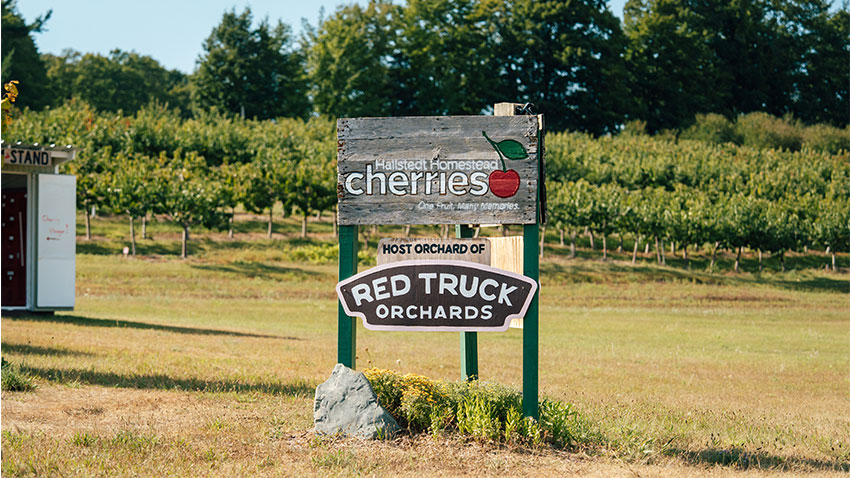
Phil: As we pivoted to launch Red Truck Orchards cherry vinegar, we strengthened the operations of the farm by hiring an orchard manager to free me up to focus on the vinegar operations, while Sarah focuses on the farm in raising the cherries, raspberries and flowers. We grow cherries, but the real harvest is the community that supports the farm and our family.
Sarah: We questioned whether we should keep doing the U‑pick cherries. It’s not really breaking even for us. I said yes because that’s who we are. That’s our authentic brand. We have a cherry orchard and people can come and see it, walk the hills, pick cherries and see the vinegar being made. We call it Hallstedt Homestead.
Phil: Authenticity is really important to us. One thing we’ve learned is people don’t know where their food comes from. People come and ask about all elements of farming. And without the U‑pick, people don’t have that connection to a real farm.
As we grow, we’ll buy fruit from other orchardists at a sustainable price. If you look at the last 70 years, cherry farmers have not been paid a sustainable price. We can develop a sustainable pricing model where we buy their fruit, make it into a value‑added product and hopefully save some farms. Our core purpose is to strengthen and support small cherry farms specifically, and that’s what we’re hoping to do.
Growing your business can be sweet. Scale up with the Small Business Support Hub network. Learn more.