
Like a Fish to Water
Mathew Wastell of Pisces Fish Machinery
As vice president of one of the few companies in the world that manufactures fish-processing machines, Mathew Wastell is scaling his business globally right from Michigan’s Upper Peninsula
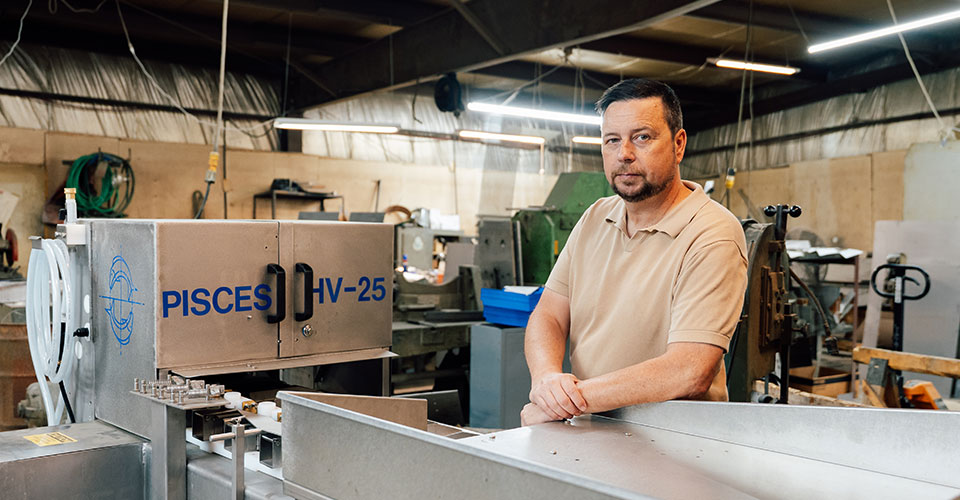
Mathew Wastell hails from the United Kingdom, but he considers the Upper Peninsula his home. He moved to Michigan with his family in the second grade, when his father took a job in Gladstone working in machine tools. His father later acquired the fish processing portion of an existing business and founded Pisces Fish Machinery in 1983, one of the only companies in the world that manufactures machines to process fish.
After graduating from Gladstone High School, Mathew attended the University of Michigan and later moved to Washington to earn his MBA at Seattle University. He worked at the Seattle office for Pisces Fish Machinery and moved back home to the U.P. after seven years. Now as vice president of Pisces Fish Machinery, Mathew carries on his father’s work to continue leading the industry.
Pisces Fish Machinery has the support it needs to remain competitive and achieve global reach thanks in part to International Trade services from the Michigan Economic Development Corporation, including Michigan’s State Trade Expansion Program (MI-STEP). Over the years, Pisces Fish Machinery has received $129,649 in MI-STEP grants, allowing the company to attend several international seafood processing trade shows, primarily in Belgium. The company has reported facilitated export sales of $18,930,174, for a ROI of $146 for every dollar received from the MI-STEP grants.
From raising his family to growing a global company, Mathew is embracing the balance that can be found right from the perch of the Upper Peninsula.

“I'm originally from the UK, and so is the founder of the business, who happens to be my dad. It's been a family business ever since he started it back in 1983.
When I graduated from the University of Michigan, it was one of those not-good times to graduate, and I was looking for what to do. And my dad said, ‘Why don't you move to Seattle and work for the company out there?’ I worked in sales and service in Seattle for that time. That got me into the industry, and then it allowed me to come back to where my family is and work here. It was very nice to be able to come back to an area like this and have a good job.
We do the primary butchering. When we get a dead fish, we will then do all the steps necessary to get it to your plate. If we take a whitefish, for instance, we have to scale it, it has to be deheaded and then it goes and gets gutted and fileted in the machine. After, it has to be trimmed and pin boned, and it's ready. It's all done at a speed that's about 35 to 40 fish a minute.

We have quite a few customers in Michigan, and we've had to expand all over the globe and start doing other different fish species. We started off doing the local fish species – smelt, perch and whitefish – and we've expanded from there.
We're always looking for new opportunities, and that's where we go to exhibitions in Europe and other places, because we are the third most popular form of protein in the U.S. where, in some countries, fish is number one. That's what they like to eat. It's also the most expensive form of protein. In Michigan, I think we process all the whitefish – all that Lake Michigan whitefish in the local area is done through our equipment.
We do a lot of business with Europe. The last piece of equipment shipped out was going to France. The next one will be Greece, France again and then Austria. We also have had quite a few shipped throughout the U.S.
We design and manufacture everything in our little factory here in Michigan. When we design a machine, the components – from the machining to the waterjet laser cutting – are designed in Michigan. We also do buy some parts from other local machine companies, which is great, such as parts from Cone Drive in Traverse City and enclosures from Saginaw Control and Engineering.

We work with different species – everything from a sardine to a great big salmon, which require different machines. Being a company run by engineers, a lot of people like designing equipment. While some machine designs haven't changed much, we're always on a quest to get more meat out of the fish.
The U.P. is a great place for business. I think the area has a good work ethic, and we've been able to get a good workforce. It's probably less expensive than other places, and because of that, we're able to get some younger people who are interested in working and want to stay in the area.
I love the area, the water and the trees. I wake up every day and look at Lake Michigan from my house. We like being in a small-town region. It's big enough, yet small enough at the same time.
The wonderful thing about living here is that it's nice to raise a family. My kids all graduated from the University of Michigan. My daughter now lives in Traverse City, which is beautiful. She's found a cross between Escanaba and a bigger city, so it's great. And my son is currently working just outside of Ann Arbor.
My sister also went to high school at Gladstone, but she's since moved back to the UK and lives just outside of London. Still, she likes to come back and enjoy our summers.”