
Thursday, July 30, 2026
Michigan’s Platform for Advanced Nuclear Energy
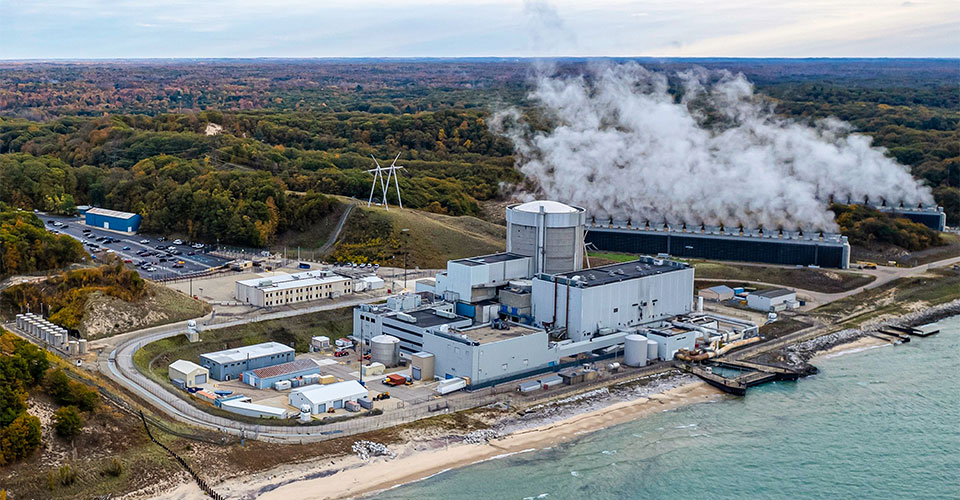
Photo Credit: Holtec Palisades
Along the shores of Lake Michigan, Holtec International is bridging Michigan’s legacy of nuclear power to the next generation of advanced nuclear energy. The company is working to bring the 800-megawatt Palisades nuclear plant in Southwest Michigan back online, for what is expected to become the first restart of a shuttered U.S. commercial nuclear plant, setting the stage for what comes next: the first deployment of Holtec's SMR-300 technology, at that same site.
Michigan isn't a newcomer to the industry. Nuclear power supplied approximately 28% of Michigan's electricity from 2011 to 2021. That operating history has built a foundation to advance nuclear energy, from small modular reactor technology and microreactors to advanced fuels, reactor components and nuclear manufacturing. It's how a company like Holtec can build its next generation of reactors here, with research depth, manufacturing strength, policy tools and coordinated support aligned around advanced nuclear deployment.
A Restart Sets Up the Future of Small Modular Reactors
Holtec, Michigan and the federal government are working together to bring the 800-megawatt Palisades plant back online. The effort is backed by a $1.52 billion U.S. Department of Energy (DOE) loan guarantee and $1.3 billion in awards from the U.S. Department of Agriculture.
“As we enter the final phase of this historic effort, we are grateful for the support provided by our federal, state and community partners, whose collaboration has helped make this pioneering effort possible,” said Dr. Kris Singh, Holtec chairman and CEO, in a press release announcing the project had entered its last phase of testing, inspection and restart readiness work.
This aligned support is a critical part of the Palisades story, as is Michigan's commitment to expanding in-state carbon-free generation. It’s among the reasons why Holtec chose to co-locate the first two SMR-300 units at Palisades. The site will anchor the company's Mission 2030 program, part of a planned 10-gigawatt deployment across North America. Each unit is designed to deliver more than 300 megawatts of electricity, with the project building on infrastructure that already exists. The DOE is backing this phase too, with a $400 million award supporting deployment activities tied to licensing, pre-construction and nuclear supply chain mobilization.
R&D and Workforce for Advanced Nuclear
Michigan’s research base gives advanced nuclear developers a practical path from technical validation to deployment. The state’s leading research universities conduct nearly all academic and federally funded R&D in Michigan, with strengths spanning nuclear engineering, advanced materials and commercialization.
Michigan’s four R1 research universities generated $3.46 billion in academic research in fiscal year 2024, and have plenty of specialties to support advanced nuclear:
- University of Michigan—home to the nation's No. 1-ranked nuclear engineering graduate program—connects industry to advanced research, students and energy leaders through reactor modeling, digital twin tools, materials testing and deployment-focused research.
- Michigan State University's Facility for Rare Isotope Beams adds a DOE user facility for rare isotope science, radiation damage studies, advanced materials insight and nuclear physics talent.
- Michigan Technological University's Keweenaw Energy Transitions Lab supports clean energy systems, grid resilience and advanced power technologies, with real-world testing built into the work.
- Wayne State University brings added depth in high-energy nuclear and particle physics, advanced instrumentation, detection systems and high-fidelity computer modeling.
That research base is matched by a nuclear workforce built for complex energy and manufacturing projects. Michigan has the country's highest concentration of engineering talent and commercial and industrial designers, along with top 10 rankings for semiconductor workforce, STEM degree completions and tech talent pipeline. These strengths are tied directly into the industry, with state programs for both near-term hiring and long-term workforce development, connecting students, institutions and employers early in the pipeline.
Legislation Built Around the Nuclear Deployment Timeline
While Michigan already has the talent and R&D pipeline to support advanced nuclear, uncertainty remains the enemy of long-horizon energy projects. That’s why the Michigan Legislature has a proposed package of bills to back that pipeline with tools for early R&D, education, workforce growth and commercialization.
The state's proposed nuclear legislative package includes:
- HB 4124: A 15% R&D tax credit for nuclear technology, fuel and power uprates.
- HB 4125 and HB 4126: Education grants to build nuclear programs at Michigan postsecondary schools, including colleges, universities and technical and vocational schools.
- HB 4127: A statutory definition for nuclear reactor technologies, aligning regulation across technology, tax and utility law.
- HB 4128: A $1.00 per kWh tax credit for electricity generated by SMRs or approved uprates.
- HB 4129: Graduate attraction and retention grants for Michigan nuclear facilities.
If enacted, these bills would lower the cost of early R&D and give companies a clearer, faster path to deployment.
Team Michigan Connects Companies to What They Need
Complex advanced nuclear projects usually mean navigating state agencies, utility providers, universities, regional partners and local communities one at a time. Team Michigan skips that, bringing speed and clarity by inviting the right partners into the conversation early.
That support can include:
- Site selection and competitive analysis
- Workforce support and facilitation
- Utility and energy coordination
- Business-friendly incentive programs
- Stakeholder alignment and announcement coordination
- Nuclear supply chain connections
Michigan's supply chain is a core part of that picture. The state's nuclear feasibility study identified Michigan-sourced products already used in major reactor projects, including heat exchangers, pumps, valves and specialty components. Team Michigan is ready to plug companies into the manufacturing base that’s already capable of building the nuclear future.
Built for Advanced Nuclear Deployment
Advanced nuclear projects need a place where partners align early, project needs are understood and the path from concept to deployment is built with clarity.
Palisades shows what Michigan can bring to advanced nuclear deployment. The state is ready to help companies move forward with aligned support, manufacturing depth and research strength around one of the country’s most complex energy opportunities.