House of Straw
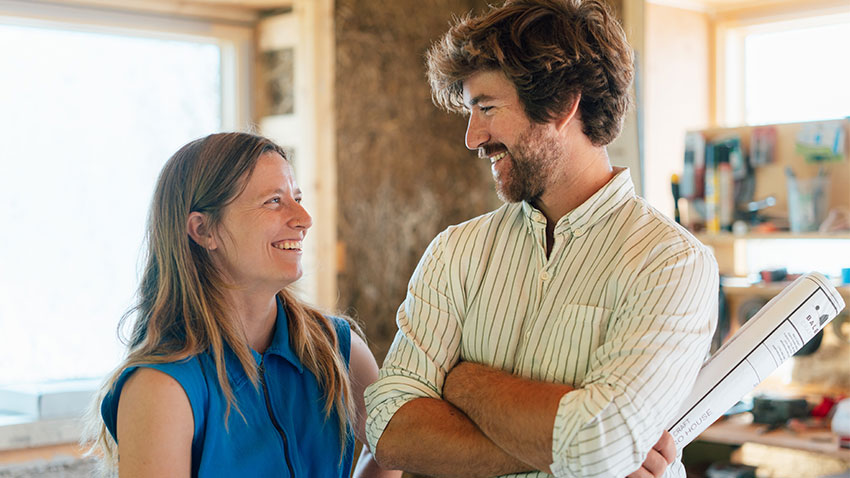
Sophie Pacelko and Ellis Wills-Begley of Bale Craft
Two Traverse City entrepreneurs are building homes with natural materials for better insulation, with a helping hand from the local MEDC-supported Small Business Support Hub.
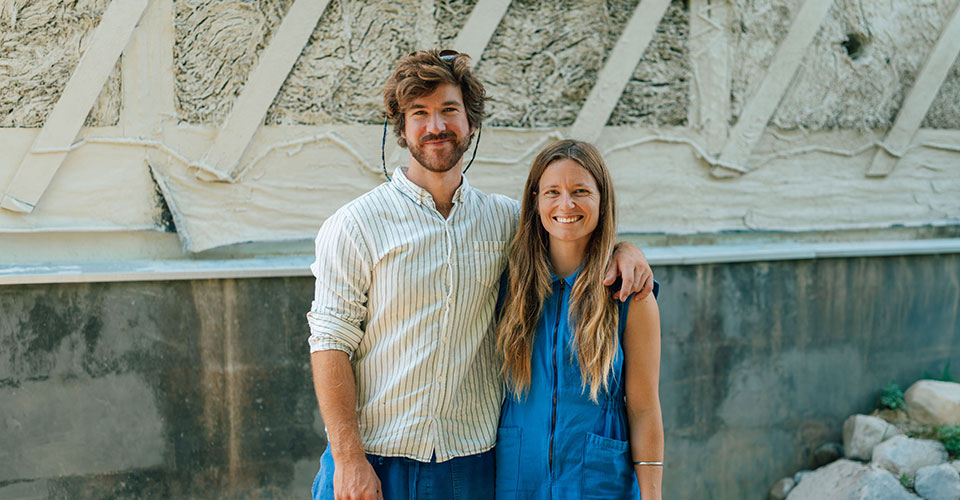
Despite the extremes of heat and cold for which Michigan is famous, better home insulation and lower utility bills may be as simple as a house of straw. In Traverse City, two co-founders are bringing a traditional building method to modern architecture, incorporating panels of compressed straw in place of fiberglass insulation. Sophie Pacelko and Ellis Wills-Begley met in architecture school at the University of Michigan, moved to Traverse City and founded Bale Craft with a goal of “crafting the built environment into a healthier, more sustainable way of life to sequester carbon for generations to come.” With support from the 20Fathoms Small Business Support Hub, funded by the Michigan Economic Development Corporation (MEDC), they were able to lay a solid foundation for business growth. Now, they’re partnering with the Crosshatch Center for Art and Ecology on the Crosshatch Meeting Place + Mercantile, a unique community space in downtown Bellaire supported by a crowdfunding match from the MEDC through the Public Spaces Community Places program.
Together, Sophie and Ellis are refining their technology, building their demonstration house and training a cadre of craftspeople to bring back traditional techniques for the volatile temperatures of today.
How did you end up building with straw here in the Traverse City area?
Ellis: Traverse City is my hometown. My dad’s an architect. My mother’s a designer. I was introduced to the industry at a young age, and loved spending time with contractors and seeing projects being built.
Sophie and I met in school at University of Michigan. We realized that we shared a lot in common and decided to partner up and move to Traverse City. Now I have my architectural license, and we’re in the early stages of making hires and trying to grow the business, slowly, deliberately, trying not to let it get out of control, because it's our first time doing this and there's a lot to learn.
Sophie: I grew up in Florida and did my undergrad degree in environmental science and soil science. I then moved to California, where I worked on a 200-acre regenerative, organic, biodynamic farm for four years. They made a movie about it called The Biggest Little Farm. It is an inspiring place.
I was really influenced by how plants form, and found out that within architecture, you can design based on these systems of plant growth, and so I applied to architecture school to translate agriculture into architecture. Now, that is quite literal.
Ellis: I had a very clear moment in undergrad at University of Michigan when professor Joe Trumpey took us students out to visit his house. That was the first time I had ever seen a straw bale house and in the middle of summer, it was nice and cool on the inside, without any heating or cooling that day, just by the thickness and R-value of the walls.
Sophie: My interest came more as an alternative material approach to modern day materials. Straw is a building material people have been using for centuries, and I am passionate about remembering our ancestors’ crafts and how we can incorporate them into today’s world. It felt like a natural progression into straw bale.
What's your impression of why straw bales for insulation became less common?
Sophie: I think that's a question we can ask about most parts of construction, and really everything. Why did we stop fixing things? Why do we buy new things every time something breaks? We’ve moved away from community involvement and togetherness. Natural building is a really high-labor activity. People used to gather and build houses together. Nowadays, society says, “No, you have to work nine to five.”
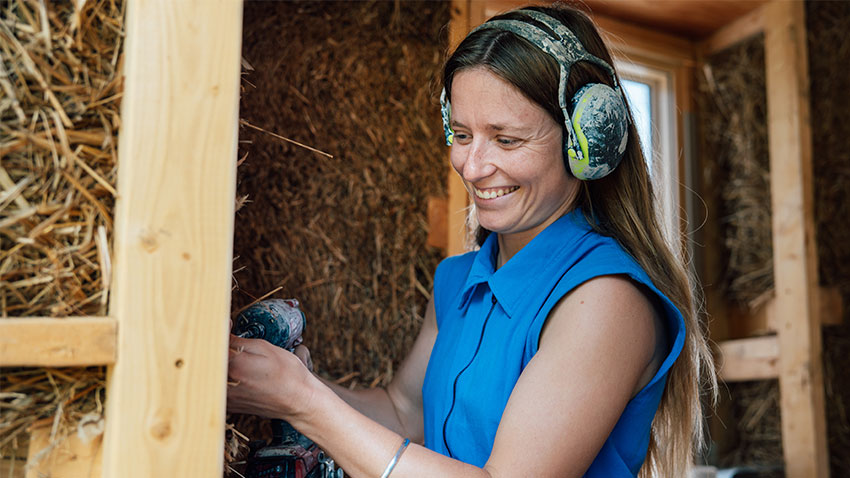
Part of why we make straw structural insulated panels (SIPs) is because they become more accessible as a building component, and require less on-site labor, so more people can use natural materials to build their homes.
Ellis: The straw SIP method is a development of traditional straw bale construction where you're stacking bales around a timber frame structure. This panelized, prefabricated method came out in the late ‘90s or early 2000s, because these natural builders wanted to bring straw bale construction to a building show. They asked, “How do we get it there?” Well, let's put it in a box, and then we'll take it. It piqued a little bit of interest, but then faded away.
About 10-15 years ago, it started coming back, and now there’s many different types of business models around the world. We saw all the benefits of reducing labor on site, and... I hate to say it, but leaning into the productization of this traditional process, so that more builders and homeowners can take it on.
We’ve positioned ourselves as primarily designers but also manufacturers, because nobody else is doing it. Little by little, we’re growing the workforce around it and trying to find other people to network with.
Between architecture, manufacturing, building, and teaching, how is your time spent?
Sophie: We've been working really hard to get Bale Craft off the ground, and as expected, we're both really excited about where we are, but still a bit over capacity. This is something that we've heard from mentors, that natural building does take a toll. There's a high expectation that you also become a teacher when you’re hired for the job, and people don't often want to pay for the teaching part of it. But we want to teach to share the knowledge and to keep it growing. It’s tricky.
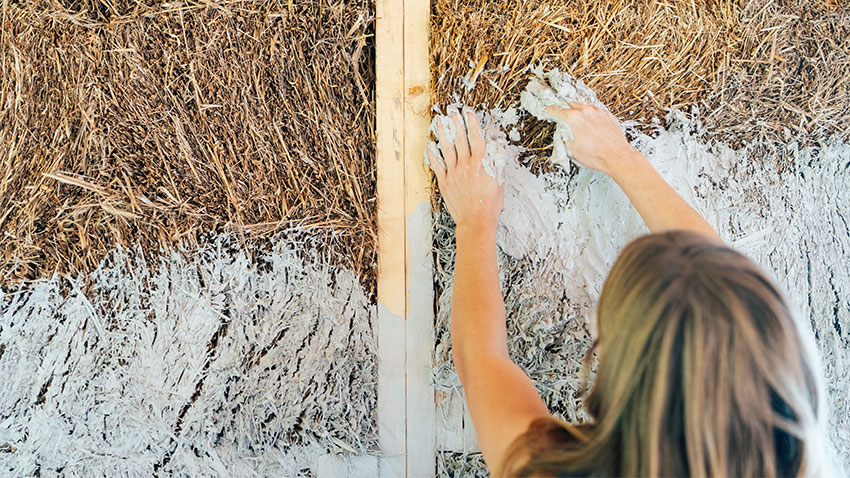
Currently, most of our time is spent building our own house, which we want to serve as a demonstration home. For a lot of people, when they think of a straw bale house, they think of a gnome home, and although that fits some people's desires, there are other ways to do it.
Since we are still early on in our business growth, we’re doing almost everything ourselves, with help from our shop manager and other helpers and friends. We’d love to move away from general contractor responsibilities and do more design work. Soon, we will start looking for a new shop space and make our first full-time hires.
Ellis: It’s going to take time to recruit interested builders who want to learn how to work with natural materials. We’re working on our first project with a licensed architect and a licensed builder, where we’re just serving as the design consultants and manufacturers. It’s taking shape, but it will take a while before there’s an entire network of general contractors who know what to do, who know where to get clay, straw and other local and non-toxic materials. Society has forgotten so quickly how to build with these materials.
How has the Small Business Support Hub program helped through your journey?
Sophie: It’s been great. Their small business grant was helpful; it gave us money to hire an attorney to help us review contracts and create a business structure, define how we share responsibility and how we can transition one day into a corporation. It also helped with engineering fees, to develop a code-compliant set of standardized panel drawings. This may be a constant work in progress, because every time we build a house, we can’t help but think of improvements.
We also recently got a grant from EGLE [the Department of Environment, Great Lakes and Energy], a NextCycle Michigan grant for waste diversion. Straw is a waste product of the agricultural industry, and a lot of it is burned, which removes the carbon capturing qualities. We received a roughly $10,000 grant to upgrade our shop equipment.
Ellis: It’s made it a lot safer, with PPE, ventilation, air filtration and hydraulic compression to compress these panels, and made it a lot faster. It put us in a position to scale and start to meet regional housing needs. The grants helped us set the foundation: the legal structure, the equipment and process. We’re so much further ahead than we ever thought we’d be. They’ve made a huge impact.
Sophie: 20Fathoms has also given us so much help as people; they are so supportive of what we're doing. You go in and mention one thing, and they think of other ways to help, like social media work or things we should include on our website.
Ellis: We’re finding that balance of what direction the company goes; do we chase grants and work on grant-funded projects like research, advocacy and teaching? Or get pulled into residential construction and design, something more in the field?
How are you collaborating with Crosshatch on the new center that they're building?
Ellis: We’ve known about Crosshatch for years. I always appreciated their work and their involvement in the community. We’ve known them to be an anchor for so many different things. They supported our natural building/healthy home symposium as direct partners and hosted it at the Alluvion. They brought us in and trusted that we knew what we were doing. We brought in mentors, colleagues, collaborators and together with their network, resources, volunteers and staff, it helped us so much to put on a community event of our own.
We applied for their RFP looking for an architecture firm to help guide them through a process on a large campus. We had to pivot away from that for now, given soil contamination that will require remediation. Since then, we’ve been helping with their build-out of a new meeting and mercantile space in downtown Bellaire. There were some unexpected roof repair needs, and with collaborations like the MEDC, that’s been helping to support that project as well. We're so grateful to be a part of the Crosshatch team on this project.
What are some of your favorite things about the Traverse City area?
Ellis: When I moved back in 2022, I met so many people in the community who were all independently working on building their homes, or renovating, and doing something meaningful. Sophie and I met so many individuals who’ve been working towards the same goals for 20 to 50 years before us, people like the builder Thomas Hirsch or architect Suzannah Tobin. People here are very involved, and care so much about their work.
Sophie: Everyone says hi to each other and waves at each other on the street. If that doesn't scream community, I don't know what does.
Ellis: I think it's a privilege in this area to have willing builders and tradespeople who want to learn something different and do something different. We've talked with other natural designers, architects and builders in other places in the country, who have been at it far longer than us and are still trying to find or build their community. We’re so grateful that people here want to learn and try something new.
No need to huff and puff. Find your local Small Business Support Hub for help to make your business last.