
Waste Not
Kendra Schneider of Takeout Takeout
With a varied background in events, international business and sustainability, Kendra Schneider started a reusable food packaging company in her hometown of Lansing, assisted by the Lansing Economic Area Partnership’s TREK Small Business Support Hub.
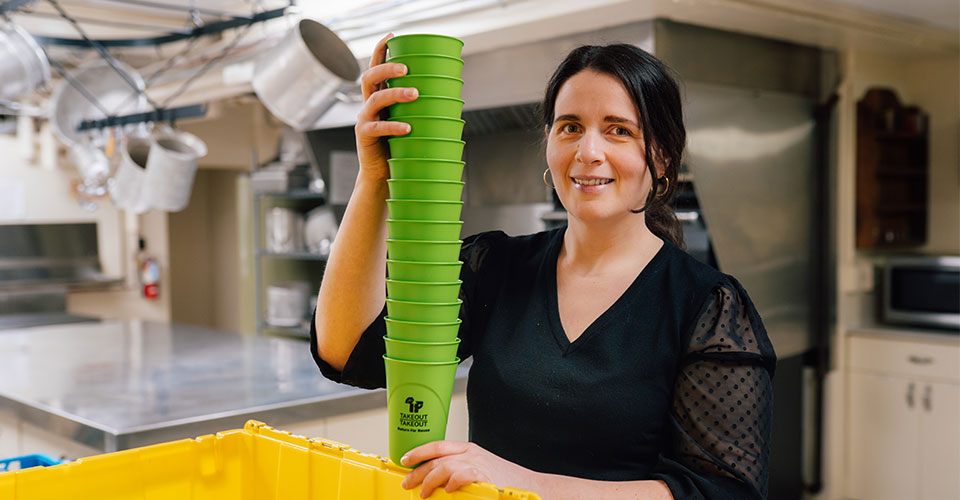
Lansing native Kendra Schneider brought her experience as a university student in Italy back to her hometown to build Takeout Takeout, a small business founded in 2022 as a “full-service reuse operations company for your business needs… a grassroots initiative that aims to tackle single-use food packaging waste in the Lansing region.”
Her business is one of the thousands of service recipients that have benefited from the Small Business Support Hub program, in every Michigan county. With support from the Lansing Economic Area Partnership (LEAP) and its TREK Small Business Support Hub, along with other LEAP programs funded through the Michigan Economic Development Corporation, the Lansing Regional SmartZone and the Mentor in Residence Program from the MSU Research Foundation, Kendra is pursuing her dream and establishing Takeout Takeout as a scalable, sustainable alternative to single-use plastics.
What is Takeout Takeout, and what makes it unique?
Takeout Takeout is a full-service reusable foodware system. We’ve all heard “reduce, reuse, recycle,” but we never made the infrastructure to support reduce and reuse. We jumped straight to “recycle.” If consumers want to reduce or reuse, they have to do it themselves. There’s nothing on a large scale.
That’s what I’m building. My original slogan was “take the trash out of takeout,” until I realized how expensive it is to integrate with restaurant POS systems. Without enough collection points, it’s challenging. I’m looking for a certain level of market saturation before returning to restaurants. My new phrase is “Reuse should be easy, so we take out the hassle.”
How did you end up building a business in Lansing?
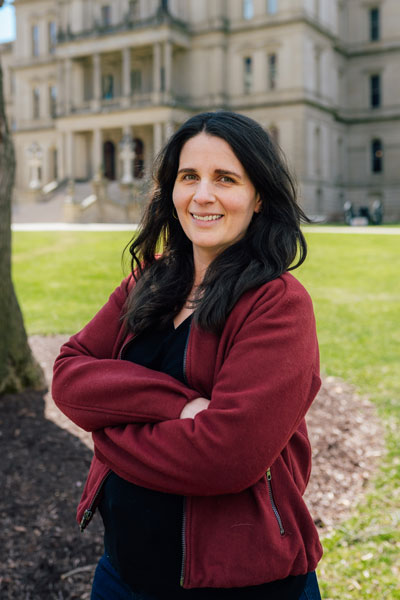
I was born and raised in Lansing and graduated from Eastern High School in 2007. After that, I went to Lansing Community College without knowing what I wanted to do, dropped out, had my daughter, then went back. Eventually, I transferred to the American University of Rome. I lived two years in Italy with my daughter, and I earned a degree in international relations and global politics with a minor in international business.
In Italy, everything was simpler. Coming back, I thought, “Why are our grocery stores so huge?” Even my parents’ fridge seemed huge after living with a smaller one. I had taken an Italian food and culture class, where we talked about American foods and food waste and how everything looks like it's been cloned. That experience made me question why we buy so much and let it go bad, and how food gets lost inside those big refrigerators. I interned with the Food and Agriculture Organization of the UN, working on a program called Rural Invest, which focused on elevating small community voices. I helped create training documents for the program. Then I interned with Love Italy, which focused on heritage preservation. I helped plan a gala for restoring a villa in Pompeii.
Originally, I wanted to open a zero-waste restaurant. But that was hard to execute. I realized it made more sense to partner with existing systems. Washing a dish is easier. Takeout Takeout was a pivot from that big dream to something more practical—but it’s still not “easy.”
I realized all my experiences fit together. Now I’m promoting reuse and dishwashing while uplifting small voices and dealing with local policy. Michigan’s food code is from 2009, and reuse isn’t allowed in restaurants unless they get a variance. My varied background weirdly all converged into this business.
What does your day-to-day work look like now?
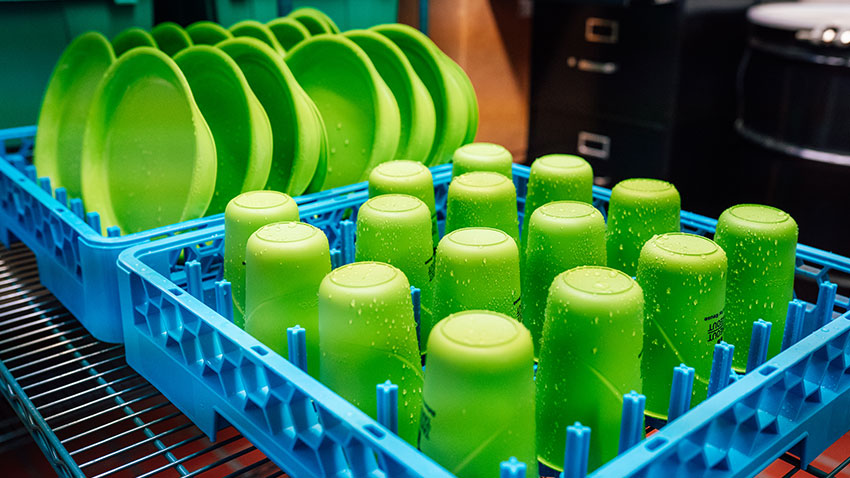
 I’ve been working for the last year to build my system, and pressing pause for now on new pilot projects. That means ordering supplies, setting up my kitchen space, counting inventory and now doing time studies to figure out how much I can wash in an eight-hour day. That helps me know how many clients I can handle and when I’ll need more space.
I’m working with Gravity Works on an inventory tracking software platform. I’m waiting for labels to come in, and once they do, we’ll test everything. I’m also starting a reuse pilot at Sycamore Creek Church. It’s fewer than 100 people and only for an hour on Sundays, so counting items manually is manageable.
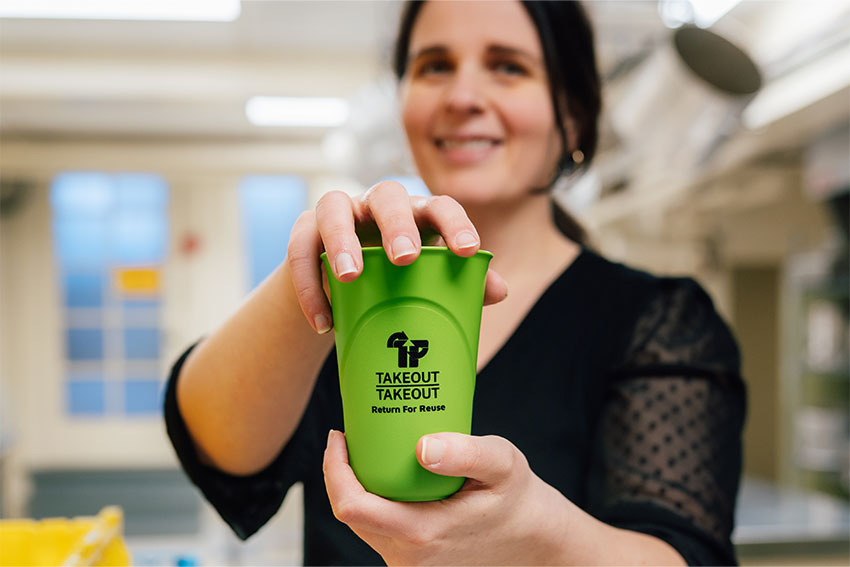
When I work with someone, I start with a consultation: average guest size, what they’ll need and logistics. I usually give double what they expect at first. I deliver the items, maybe 100 cups, and note that in my tracking system.
In the contract, we agree on pickup and washing schedules. I check everything back in, identify any damage, wash items and return them.
It can be a one-off event or a recurring schedule. For example, for an informal corporate dining space that wants reusables but doesn’t have dishwashing capacity, I can deliver a week’s worth of dishes and pick them up regularly. It’s like a linen service, but for dishes.
How does the pricing compare to other options?
It’s tricky. That’s why a lot of reuse companies focus on big events; they can get sponsorships. Stadiums partner with Pepsi or Coca-Cola for good PR because of their pollution issues. It is more expensive than single use, but with global conflicts raising oil prices, single-use packaging is going to get more expensive too. And with supply chain issues, like during COVID, local reuse is more reliable.
What are some of your most memorable experiences from starting the business?
I remember self-funding my first small batch of reuse containers for Abundance Café. I sat in my room with label stickers thinking, “Okay, I’m doing this.”
At Abundance Café, customers used the containers for takeout and returned them. Once customers understood how it worked and that everything was sanitized in a commercial dishwasher, they wanted to participate. For two years, it worked without a tracking system, purely on community integrity.
How have you engaged with the Small Business Support Hub (SBSH), and how has it helped?
I did the LEAP One & All program. I still feel this way: every time I do a business accelerator, I’m at a very different point. People are doing businesses that you’ve heard of, and here I am, trying to build this new thing. I ask, “How does that relate to me? How do I apply that to me?” Cost of goods sold usually refers to inventory you sell, but mine comes back. Even if something sits for a bit, it’ll go out again. My financials look odd. I had to write a note at the bottom explaining how I calculated everything.
The Support Hub and working with their mentors made a difference. Doing their “power hours” gave me a space to work and people to bounce ideas off. I like that. Having multiple mentors helps; one fills in what another misses. Meeting every two weeks has been great. Sometimes it’s business, sometimes it’s personal. Entrepreneurship can be lonely, and people don’t always understand what you’re doing. So having someone to talk to, even cry to, is helpful.
Looking ahead, what are your hopes for the business?
I want this to be a blueprint for a sustainable city, where reuse infrastructure is normal (and branded!) Larger programs get funding but often miss the local community. Stadium programs don’t always reach the residents who live around them. I want something the whole city knows and uses.
What do you love about Lansing?
I grew up here. It’s a “little big town.” There’s stuff to do but it’s not overwhelming. After living in a big city, I appreciate the suburbs, the quiet, the lack of congestion. It’s always felt like home.
People complain about what we don’t have, but I think: if you want something, make it. Create the event, the restaurant, the experience. That’s why I started here. When I first researched reuse programs, they were all in California or New York.
I thought, “When is this coming to Michigan?” Then I decided to just do it myself.
Waste not the opportunity to learn more about MEDC’s small business services.