
Success Story
Payload CMS
James Mikrut had an idea to fix a big problem in web development: the gap between design and code. With the support of MEDC-backed incubator Start Garden in Grand Rapids, he grew Payload CMS into a company that’s been acquired by a rising giant.
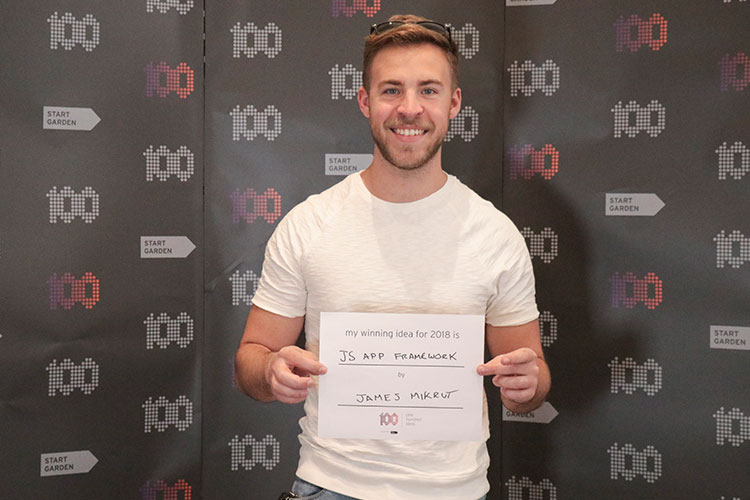
The story of Payload CMS starts with James Mikrut, a Grand Rapids web developer, and The 100 in 2018. An annual pitch competition organized by Start Garden, a SmartZone and Small Business Support Hub in Grand Rapids funded by the Michigan Economic Development Corporation (MEDC), The 100 is open to anyone to submit their business idea as a 100-second video. 100 finalists are selected to receive $1,000 each and prepare a demonstration, and winning presenters then receive $20,000 to continue building their business . As “a no-strings-attached way to fund people to take a shot at new endeavors each year,” The 100 is based on the idea that “not everybody is an entrepreneur, but everybody should have a shot at becoming one.”
As a new and somewhat complex program, The 100 needed a dedicated, powerful and flexible website. Mikrut offered a proposal to build it and suggested an exciting approach: a new “headless” content management system (CMS), using the latest Node and React JavaScript frameworks. Start Garden director Paul Moore recalls responding, “Thank you, but we don't need all that. However, you should pitch for the competition.”
Mikrut was accepted into the competition and won. He moved into Start Garden and continued to develop his ideas and codebase along with fellow founders Elliot DeNolf and Dan Ribbens.

The Concept
As the founders later described themselves, “We're three full-stack engineers that have built digital projects with existing CMS for over a decade—including enterprise websites for big names like Klarna. We knew what we wanted, but also intimately knew it didn't exist, so we built it.”
As developers, they frequently hit roadblocks while trying to adapt popular CMS platforms like WordPress or Drupal to their needs. “To developers, ‘content management system’ is a swear word.” Instead, they wanted a CMS “that is obsessed with giving engineers the best developer experience possible,” one that provided the flexibility, self-hosting capability, and ease of content maintenance offered by WordPress without the security vulnerabilities, coding difficulties, or other complications associated with the platform.
To make that happen, they needed time and space to bring the idea that became Payload CMS to maturity. Start Garden provided the perfect environment.
The Incubator
Through Start Garden, the founders received the support and connections they needed to thrive. “The incubator is like the additional staff member that's supporting entrepreneurs, because we had an ongoing relationship around where their growth was headed, what they were challenged with, can we help them find React developers, the general day-to-day stuff,” said Moore.
Thanks to the low-cost coworking space provided by Start Garden, proceeds from the founders' web development work for clients could be funneled into development of the new CMS. “They were using their day hustle to fund their side hustle, which allowed them to work on the product for a much longer time than an accelerator program, where it's a 12-week sprint,” said Moore. “They really got to know their product and their customers over a good three or four years.”
In addition, the SmartZone covered the costs for a group of founders to attend the SXSW conference in Austin, Texas, each year. “James was talking to the founder of a healthcare startup that had come out of Y Combinator into the wee hours of the morning at SXSW and realized, ‘Maybe Payload could get into this.’ It always seemed outside of the realm of possibility, but that gave them the confidence to apply,” said Moore.
The Launch
Mikrut, DeNolf and Ribbens launched the first public beta release of Payload CMS in January 2021 and began teaching the web development community how to use it. The next year, they were accepted into the summer 2022 batch for prestigious accelerator Y Combinator. In a key business decision, they made Payload free and open source in May, and in November announced that they had raised a $4.7 million seed round, led by Google’s Gradient Ventures.
With funding secured, the founders had a choice to make: leave for another state, or remain rooted in Michigan? They chose to purchase a building in west Grand Rapids and built the company to 10 full-time employees, before growing demand for Payload brought them to another decision point in October 2023. With the support of an MEDC Michigan Business Development Program grant, they decided to expand in Grand Rapids. According to MEDC partner The Right Place, there are more than 19,000 information technology jobs in Greater Grand Rapids as of 2023, with a projected growth rate of 19% from 2023-2033.
“Payload is the tip of the spear that is turning Grand Rapids into the tech hub of the Midwest and putting this region’s technological prowess on the map globally,” said Mikrut at the time of the announcement. “While the coasts are traditionally viewed as being more entrepreneurial in the tech space, we've built an amazing team from the ground up in Michigan, where we believe there is a strong pool of high-potential creatives who want to work on highly technical products, and we're going to find them. We look forward to leveraging our partnership with the MEDC and The Right Place to help us offset some of the challenges of scouting and retaining world-class talent right here in Grand Rapids.”
The Outcome
On June 17, 2025, Mikrut announced that Payload had been acquired by Figma, a leading website design platform. Mikrut described their joint vision in problem-solving terms: “The gap between design and code still exists. Designers create in Figma, then devs recreate in code, then content teams struggle to maintain it all. It’s inefficient and frustrating. And historically, the CMS tends to make it worse. With Figma, we can (and will) solve these problems in new ways without compromising.”
Figma Chief Technology Officer Kris Rasmussen offered high praise, saying, “I’ve been blown away by this team, their product, and the trust they’ve built in just a few years. The fact that Payload is already used by several Fortune 100 companies is a testament to that.”
While terms of the acquisition were not disclosed, its successful exit puts Payload CMS in rare company as part of the roughly 1-3% of startups that are acquired each year, only three years after participating in Y Combinator. “That rocket ship that they took between Y Combinator and selling the company was the result of being able to slow down and fully understand the product and the customer,” said Moore.
“Without Start Garden and our partnership with the MEDC, Payload CMS wouldn’t be where we are today,” said Mikrut. “Over the next few years, we’re going to build things that only we can do. We’re going to fix problems that no one else has even thought about before, and we refuse to make any compromises as we do it. There's a lot of opportunity to fix things in the digital design industry that haven't ever been fixed before. For us, that opportunity is right here in Michigan.”