
Thursday, April 30, 2026
Discover Southwest Michigan
With support from a Make MI Home grant, the Southwest Michigan Regional Chamber accelerated their award-winning population growth program, Discover Southwest Michigan, and identified 1,500 households interested in moving to the area.
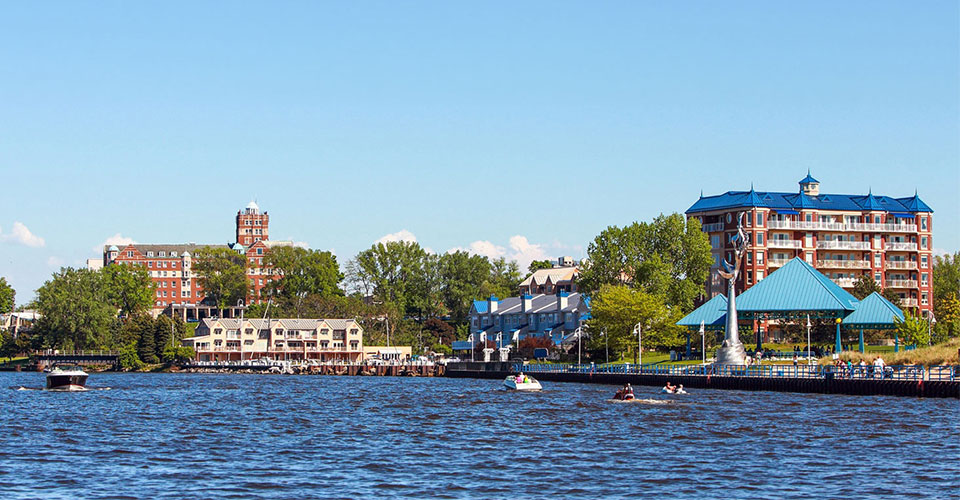
What will it take to grow Michigan’s population? It’s a question the state has grappled with for the past several years. In Southwest Michigan, where population decline has been a reality since 2010 for Berrien, Cass and Van Buren County, it’s a question of some urgency.
Through its talent attraction effort, Discover Southwest Michigan, the Southwest Michigan Regional Chamber (SMRC) is turning some of the techniques of tourism promotion toward identifying and cultivating people who want to live there. With the support of a Make MI Home grant, they’ve found more than 1,500 households ready to move to their region, as part of the turnaround that created Michigan’s net domestic gain in population in 2025, its first since 1990.
An Economic Challenge
In Southwest Michigan, the tri-county area of Berrien, Cass and Van Buren Counties has steadily decreased in population each year since 2010. Without intervention, the decline was projected to continue through 2050.
“Peak population was really in the late 1970s, and it’s been a steady outflow ever since,” said Arthur Havlicek, President and CEO of the SMRC. “It’s slow enough that it never caused widespread panic, but when you look at the trends, and especially at the demographic shifts ahead of us, our chamber started looking at population as the number one existential threat for the region.”
The trend presents an economic challenge: as aging community members retire from the workforce, businesses are left with fewer and fewer workers to fill the vacancies that are left behind. This has become a pressing issue in several of the region’s primary industries, including healthcare, manufacturing and agriculture. In addition, the region was a “net exporter of talent” and struggled with an exodus of young, skilled workers who leave to pursue careers out of state.
With a shared understanding of the problem, regional stakeholders came together to look for solutions to grow the population. “We view it as one of the most objective metrics of success for any community, whether people are choosing to move in or move away,” said Havlicek.
Selling Quality of Life
Around the same time, Michigan launched the Make MI Home pilot program, which was an excellent fit for their goals. “I think our region was just a little ahead of the game, because we were heading this direction anyway,” said Havlicek. “Our paths converged with MEDC, which put some resources into what we were already trying to do. It really supercharged our efforts.”
Tourism-based campaigns have been common and successful in Southwest Michigan. The Pure Michigan campaign, which celebrates 20 years in 2026, is noted for its strong conversion rates and return on investment. SMRC decided to apply the same logic to talent attraction and population growth, with a tailored message toward fulltime residency and local employment.
“The Regional Chamber is really well-suited for this work,” said Havlicek. “From tourism support to business attraction, we’re constantly championing our communities. So, we came to employers and said, ‘You’re competing with others all over the country for talent. What if we work together to recruit people? You sell your workplace and we’ll sell the community.’ It’s been working well.”
3,800 Potential New Residents
The MEDC partnered with a national company called Make My Move, which specializes in talent attraction and relocation. Through the Make My Move platform, anyone looking to relocate can find information about available incentive programs, enter their information and allow SMRC or other local partners to communicate with them over the course of their decision and moving process.
“Since the launch, we’ve had 1,500 applications to move to Southwest Michigan, all in less than a year. That’s phenomenal,” said Havlicek. “That represents about 3,800 potential new residents. While we won’t get all 3,800 moving here, the annual economic impact if they did would be $54.5 million.”
Coincidentally, 3,800 is roughly equal to the population loss for the tri-county region since 2010.
Of the 1,500 applicants, many have moved forward in the pipeline. “We have 51 movers with a target move date within three to six months. Another 900 or so are qualified at greater than six months,” said Havlicek.
“As part of the application process, potential movers have to find both a place to live and a place to work. We’re helping them with both, and it’s a process. We’re close — we’ve got a few who are all the way at the end, finalizing details, and a good chunk within a few months of formalizing the decision to move.”

Lessons Learned
One of the benefits of seeing 1,500 applications in one place is the information that emerges. SMRC can see breakdowns by industry, which allows them to be proactive. For example, they can reach out to the local health system if there are many healthcare professionals in the pipeline and connect with their talent acquisition teams to see if any are a fit for open positions.
“We also see housing preferences: rental budget, home budget, beds, baths, pet-friendly, housing type. That gives us great insight into what people want and helps us tailor our approach to housing stock,” said Havlicek. “Younger folks are looking for move-up housing at a reasonable price point, with lots of interest in multifamily. Multifamily can be contentious for various reasons, but this is the housing stock needed to sustain Southwest Michigan for another generation.”
In Southwest Michigan, the current housing stock is “overwhelmingly single-family homes with larger lot sizes,” said Havlicek. “People want smaller footprints and more affordable price points, which requires more density. We haven’t been building that. I can count on one hand the number of apartment buildings constructed since the 1980s. Everyone else stopped in 2008; Southwest Michigan stopped in 1980, before it was cool.”
The additional insight provided through Make My Move is already impacting development decisions in the region. “Now we have data, both quantitative and qualitative, pointing to the stock we need to prioritize,” said Havlicek. “We can see what we need for zoning and ordinances. That lets us bring in our Rolodex of developers and play matchmaker based on what communities can and will do. We’ve had success being intentional and making organic fits.”
Taking It Statewide
The “virtuous cycle” of alignment, effort, learning and intervention in Southwest Michigan shows the kind of local leadership needed to continue the turnaround in Michigan’s population. It starts with awareness.
“If people aren’t acutely aware of the trend lines in their community, they should be,” said Havlicek. “Relying only on the census every 10 years isn’t enough. Population growth should be one of the most objective North Stars, and everyone should be able to rally around it.”
SMRC shows the value of an organization or group of leaders willing to connect community priorities back to population targets — making places attractive for people to live, work and play, with big effects for the entire community.
“When we orient our entire economic development strategy around population and growth, it creates a lot of alignment in the region,” said Havlicek. “It changes the narrative and creates more space for collaboration around multifamily housing. People come to understand it’s about growth. A developer is putting capital at risk to help our community grow. And finally, it forces you to look at the ecosystem, not economic development in a vacuum. Have we removed barriers around childcare, housing and transportation, which are the constraints we hear about constantly? Do we have leaders making the right policy decisions to be attractive and pro-growth?”
By establishing population as the community’s key metric, the Southwest Michigan Regional Chamber is showing the power of putting people first.
Learn more about Michigan’s talent attraction efforts through You Can In Michigan.