
The New Foundations of Defense Competitiveness
Executive Summary
The U.S. defense and aerospace industry is at a critical inflection point where states are now expected to be proactive, strategic partners in national security. Based on a national survey of senior industry executives, this report from the Washington Post Creative Group identifies the four pillars — workforce, infrastructure, advanced manufacturing, and innovation — that now define regional competitiveness. By exploring Michigan as a reference example, the analysis reveals how system-level alignment and deep industrial roots can close vulnerabilities in the national industrial base. Discover the strategic insights needed to navigate a landscape where resilience has overtaken efficiency and coordinated ecosystems have become essential to long-term mission success.
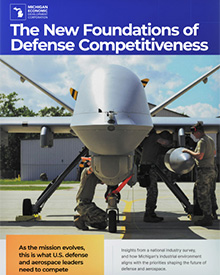
The New Foundations of Defense Competitiveness
Access White PaperContributors

John T. Gutierrez
Colonel, U.S. Marine Corps (Ret.); Executive Director, Michigan Office of Defense & Aerospace Innovation

Bill Rapp
Global Strategic Sourcing Manager, General Dynamics Land Systems

Colleen Hau
Managing Director, Newlab Detroit

Erin Strang
President and CEO, Central Michigan University Research Corporation

Matt Warnick
CEO, American Rheinmetall
Watch
The Future of Defense Manufacturing
With up to two million manufacturing jobs projected to go unfilled over the next decade, defense and aerospace leaders are completely rethinking where and how they build. A new industry survey from Washington Post Creative Group, in partnership with MEDC uncovers the four critical pillars required to keep national security manufacturing moving forward.
Inside the Report
- Strategies for addressing demographic declines in skilled trades and technical talent while building long-term workforce pipelines
- The strategic value of multi-domain testing environments, site readiness, and four-season testing for rapid deployment
- Shifting supply chains from narrow optimization toward secure, resilient, and surge-capable production
- Overcoming the commercialization gap through applied R&D and dual-use pathways
- A deep dive into one of the nation's largest defense supplier networks and its uniquely collaborative statewide strategy
Key Insights
Talent is the top constraint- 90% of survey respondents report recruitment difficulties, making long-term talent strategy the most influential factor for relocation choices
- 98% of industry leaders are actively preparing for supply chain localization or reshoring to mitigate global fragility
- Access to applied R&D and research partnerships is ranked as important by 82% of leaders when evaluating innovation potential
- 77% of respondents indicated that proximity to defense installations directly influences their current location and expansion decisions
The future of American defense manufacturing will belong to the states that can integrate innovation, industrial capacity, and workforce readiness into a single coherent strategy.