
Wednesday, August 12, 2026
The Belle
A century-old building in Detroit’s famed Paradise Valley district gets a second act with support from the MEDC’s Revitalization and Placemaking program
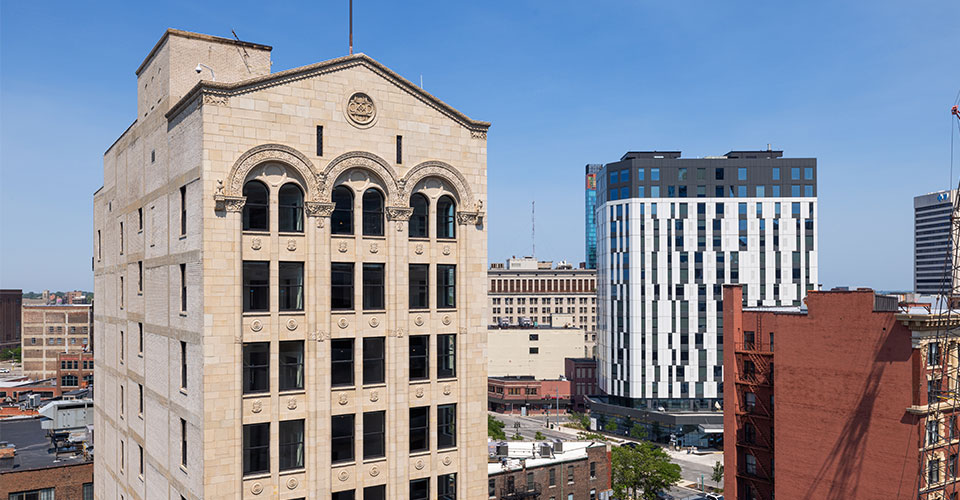
Originally built in 1926 and designed by George D. Mason, the famed architect behind the Grand Hotel on Mackinac Island and Detroit Masonic Temple, the mixed-use building now known as The Belle has seen many iterations over the past century.
Purchased by Bedrock in 2017, the building underwent extensive historic restoration and redevelopment to become a 42-unit apartment building featuring retail and restaurant space on the first two levels. The Belle opened in June 2026 and is already welcoming tenants, marking the beginning of a new era for the Paradise Valley corridor that is rich in history and steps from Detroit’s thriving sports and entertainment district.
The project was a part of a series of development and public space enhancements from the Downtown Detroit Partnership (DDP) that received support from the Michigan Economic Development Corporation (MEDC) in September 2022. Through the MEDC’s Revitalization and Placemaking (RAP) program, DDP was awarded $13.74 million across multiple projects in Detroit, including $4,996,050 to bring The Belle to life.
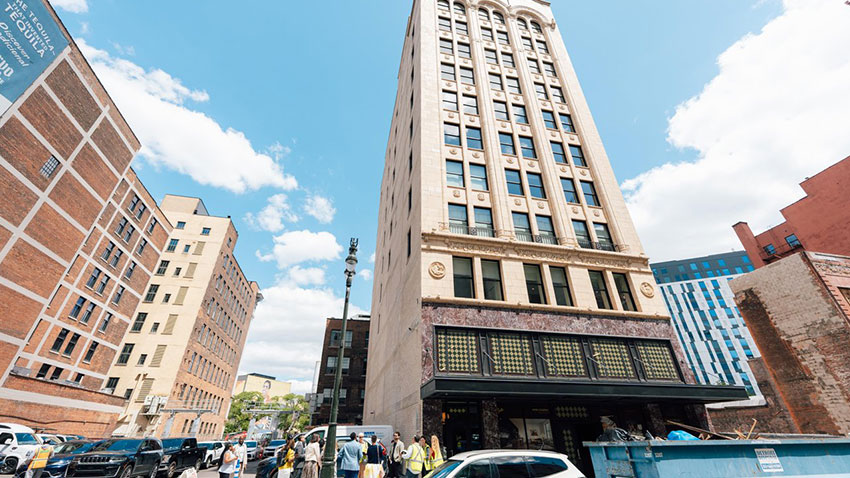
Located at 1346 Broadway Street, the 11-story structure serves as a prime example of Beaux-Arts architecture in Detroit, featuring a façade of terra cotta and marble elements. With a century of history, The Belle honors its roaring past while celebrating a new beginning.
On Broadway
“There is a storied history in the Lower Woodward and Paradise Valley Historic Districts, and Broadway previously had been a bustling center of activity in the city – filled with businesses and artisans, from clothiers and milliners to florists and hair salons,” said Spencer Golden-Sims, Senior Development Manager for Bedrock. “A testament to the street’s rich and thriving past, Broadway was renamed from Miami Avenue due to its nickname as ‘the Broadway of Detroit.’”
First known as the Broadway Exchange Building, the building was used as offices for marketing firms and insurance companies, as well as professionals like architects, lawyers and doctors. The building then became known as the American Radiator Building for its largest tenant, the American Radiator Company and its successor the American Radiator and Standard Sanitary Corporation, which occupied space into the 1940s.
It was known as the Phillips Building in the 1950s, then Harvard Square Centre starting in 1977. By the 1990s, the floors were largely vacant except for the Paris Bar nightclub on the first floor, which later closed in 2015.
In 2004, Harvard Square Centre was listed on the National Register of Historic Places as part of a grouping of 11 commercial buildings built between 1896 and 1926 known as the Broadway Avenue Historic District, further cementing its significance.
Saved by The Belle
After the building was purchased by Bedrock and the project received support from the MEDC, the challenging work of reimagining and reviving the site began; construction began in 2024. Bedrock – along with lead architect Kraemer Design Group, general contractor Roncelli, Inc. and Pophouse for interior design and brand design – approached the project as a labor of love.
“Restoring a 100-year-old historic building often costs significantly more than constructing a ground-up building,” said Golden-Sims. “Structural upgrades, historic facade preservation and environmental remediation drive up costs in the complex art of adaptive reuse projects. Without intervention, historic properties can sit vacant for decades, casting a shadow over communities and nearby businesses.”
The Belle stands as a prime example of what happens when public gap financing unlocks private investment. Through the allocation of RAP gap funding administered by MEDC, a critical capital bridge was necessary to move the project from blueprint to reality. By covering a portion of costs attributable to historic rehabilitation standards and infrastructure upgrades, the funding allowed Bedrock to break ground.
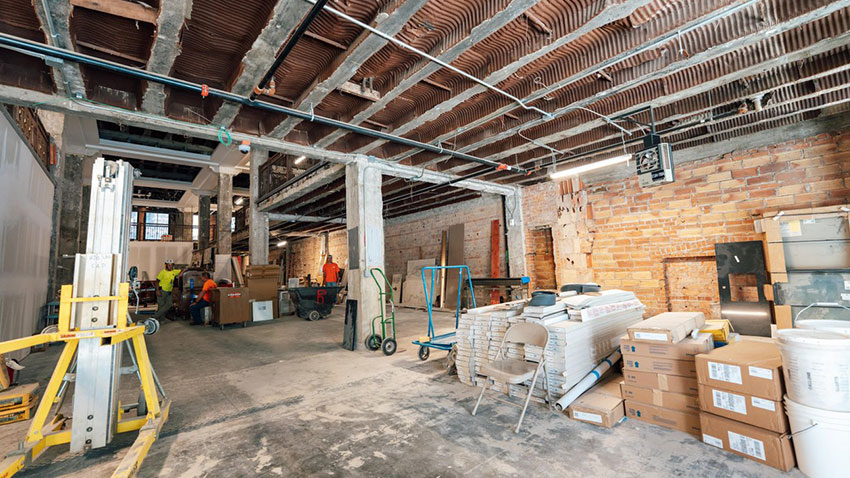
From restoring the original plaster ceiling in the lobby and repairing the interior’s marble wainscoting to upgrading the building’s elevators, the project brought aesthetic, structural and historical challenges.
“Upgrading the elevators was a major challenge,” said Brian Rebain, Principal at Kraemer Design Group. “Two small passenger elevators were in a narrow shaft landlocked between the main stairs and the front entry lobby. Only one modern elevator fit in the existing shaft and the passenger elevator had to be custom built to maintain the existing door openings.”
According to Rebain, the walls were clad historically with marble wainscoting, which was intact in most areas and needed to be retained for compliance with the Secretary of the Interior’s Standards. Adding to the complexity of the corridor construction, the consistent pattern of historic door locations on each floor had to be retained along with the historic transoms and trim profiles.
“The solution was a unique double layer wall construction providing a two-hour fire rated backer wall with veneer partition on the corridor side allowing for finished drywall, salvaged marble wainscot, doors, transom and trim, all aligning to replicate the historic corridor design accurately,” Rebain added. “In certain locations, historic wood doors and transoms were salvaged from the building, restored and reinstalled within the veneer partition, thus allowing the historic door locations to be retained after rehabilitation.”
The Toast of Broadway
In June 2026, Bedrock celebrated the ribbon cutting and official opening of The Belle, marking a new chapter for the storied building. The Belle is among other redevelopments along Broadway that are revitalizing the Paradise Valley district, including the MEDC-supported Broadway Lofts project from Basco currently in development. Standing tall in the center of it all, The Belle symbolizes the past, present and future of Detroit.
“This debut is a testament to the growth and revitalization that continues across our city and along the Broadway corridor,” said Golden-Sims. “Every new investment strengthens the community, supports local businesses and helps build a more vibrant and inclusive future for residents and visitors.”
Learn how the MEDC helps support the growth and revitalization of communities across Michigan.